

TL;DR:
- Flower decorations in event towers are elevated floral installations that become focal points, shaping space and mood at various events. They define zones, guide guest movement, and create memorable visual and psychological impacts, especially when integrated early into event planning. Properly designed floral towers boost aesthetics, enhance guest experience, and provide valuable photographic opportunities, making them a strategic investment for large and high-end occasions.
Flower decorations in event towers are defined as elevated floral installations that transform vertical structures into immersive visual anchors at weddings, corporate functions, and private gatherings. Unlike a simple table centrepiece, a floral tower commands an entire zone. It frames ceremony arches, flanks head tables, and signals to guests exactly where the action is. The industry term for this approach is architectural floral design, and it goes well beyond decoration. When you understand why use flower decorations in event towers, you unlock a tool that shapes space, mood, and memory in equal measure.
How do flower decorations in towers enhance event aesthetics?
Floral design as architecture transforms flowers from passive accents into spatial storytelling devices. A tower installation does not simply sit in a room. It redefines the room’s proportions, draws the eye upward, and creates a sense of occasion that low arrangements cannot match.
Height and scale are the two most powerful tools in floral tower design. A 1.8-metre tower of white peonies and eucalyptus beside a ceremony arch creates a completely different spatial experience than a matching table arrangement. The vertical dimension adds grandeur and makes even modest venues feel considered and luxurious.
Colour and texture do the heavy lifting for mood. Soft blush roses and trailing jasmine read as romantic and intimate. Deep burgundy dahlias with dark foliage read as dramatic and formal. Bright citrus-toned gerberas and tropical leaves signal a vibrant, celebratory atmosphere. Each combination tells guests what kind of event they are attending before a single word is spoken.
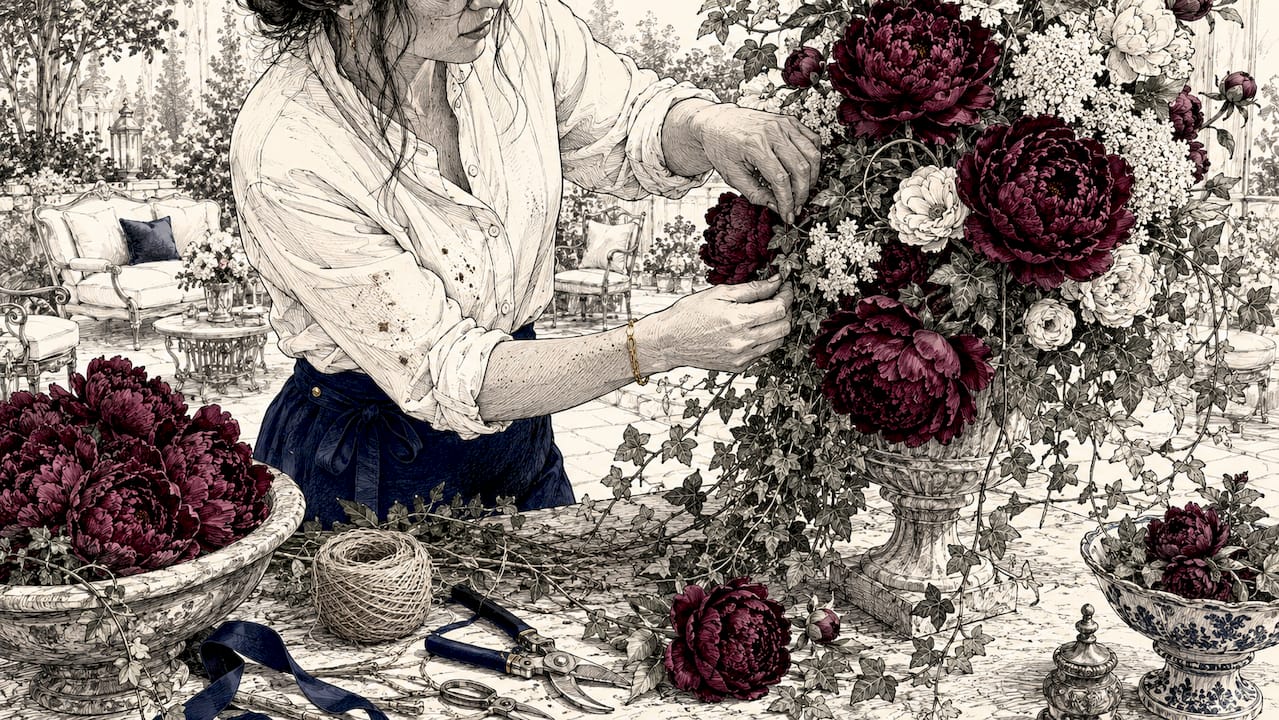
Pro Tip: Layer three distinct flower types at different heights within a single tower: a statement bloom at the top, a mid-level textural filler like waxflower or gypsophila, and trailing greenery at the base. This creates depth and prevents the flat, one-dimensional look that undermines expensive installations.
The most memorable luxury weddings and corporate events treat floral towers as focal axes rather than accessories. At high-end venues across the UK, designers position towers at room entry points, beside champagne displays, and at the corners of dance floors to guide the entire guest journey through the space.
- Use contrasting textures (smooth petals against spiky foliage) to add visual interest at close range
- Position towers at odd-numbered intervals along a wall for a natural, balanced rhythm
- Match tower height to ceiling height: a 2-metre tower in a 3-metre room feels proportionate; the same tower in a 6-metre room disappears
- Incorporate lighting rigs directly behind or beneath towers to amplify colour and create shadow play
What psychological benefits do flower towers offer guests?
The benefits of flower arrangements extend well beyond the visual. A 2025 study on hydrangea colour and structure found that viewing flowers produces measurable reductions in negative mood and stress, with specific colours and structural forms influencing attention and physiological arousal. This is not a soft claim. It is peer-reviewed evidence that the flowers you choose directly affect how your guests feel.
Colour psychology plays a specific role here. Cooler tones like lavender, white, and pale blue calm the nervous system and reduce anxiety. Warmer tones like coral, yellow, and red stimulate energy and social engagement. For a wedding reception where you want guests relaxed but celebratory, a combination of warm and cool tones in the floral towers achieves both effects simultaneously.
Large-scale floral installations act as experiential centres that guide visitor attention and encourage guests to move through a space rather than cluster near the entrance. This is a practical benefit that most planners overlook. A well-placed tower draws guests deeper into a venue, distributing the crowd and improving the flow of the entire event.
“Elevated floral installations alter guest perception from passive observation to immersive experience.” — Irene Co Events
The social media dimension is equally significant. Bespoke event flowers create highly photographable backdrops that increase organic reach for product launches and corporate events. Guests photograph themselves in front of striking floral towers and share those images instantly. That organic content extends the event’s visibility far beyond the room. For corporate clients, this translates directly into brand exposure at no additional cost.
How do flower towers support practical event design?
Treating florals as infrastructure rather than last-minute additions is the single biggest operational shift a planner can make. Florals integrated early into production timelines avoid conflicts with staging, rigging, and lighting rigs that are notoriously difficult to adjust once installed.
Here is how to integrate floral towers effectively into your event production schedule:
- Brief your florist at the same time as your AV and lighting teams. Towers placed after lighting is rigged often end up in shadow or block key fixtures entirely.
- Confirm structural load points with your venue. Some towers require floor anchoring or wall fixings that need advance approval.
- Schedule floral installation before furniture placement. Moving a 2-metre tower around fully dressed tables is a recipe for damage and delay.
- Build a contingency window of at least 90 minutes. Fresh flowers require conditioning time after transport, and structural adjustments always take longer than expected.
- Photograph the installation from every guest sightline before the event opens. What looks perfect from the front can have visible gaps or structural supports showing from the side.
Engineering floral towers requires armature structures rather than simple vases or containers. An armature is a metal or foam framework that holds flowers at precise angles and distributes weight evenly. Without one, tall towers lean, shed blooms, and lose their shape within hours of installation.
Pro Tip: Ask your florist to specify the armature material and weight distribution plan before signing off on a design. A beautiful sketch means nothing if the structure cannot hold its form for eight hours in a warm venue.
Flowers also serve a spatial function that hard décor cannot replicate. They soften the sharp edges of staging, conceal unsightly cables and structural supports, and create natural visual barriers that guide guest movement without the institutional feel of rope barriers or signage.
How do flower towers compare with other event decoration approaches?
Elevated flower towers improve sightlines and create focal points that low centrepieces simply cannot achieve. The comparison matters because budget decisions often come down to choosing between the two approaches, and the trade-offs are real.
| Feature | Elevated Floral Tower | Traditional Tabletop Arrangement |
|---|---|---|
| Visual impact across the room | High: visible from all guest positions | Low: visible only to nearby guests |
| Sightline obstruction at tables | None | Can block cross-table conversation |
| Guest interaction | Draws movement and photography | Passive, stationary accent |
| Installation complexity | High: requires armature and early setup | Low: placed on arrival |
| Cost per unit | Higher | Lower |
| Suitability for large venues | Excellent | Limited |
| Scent concentration | Dispersed across space | Concentrated at table level |
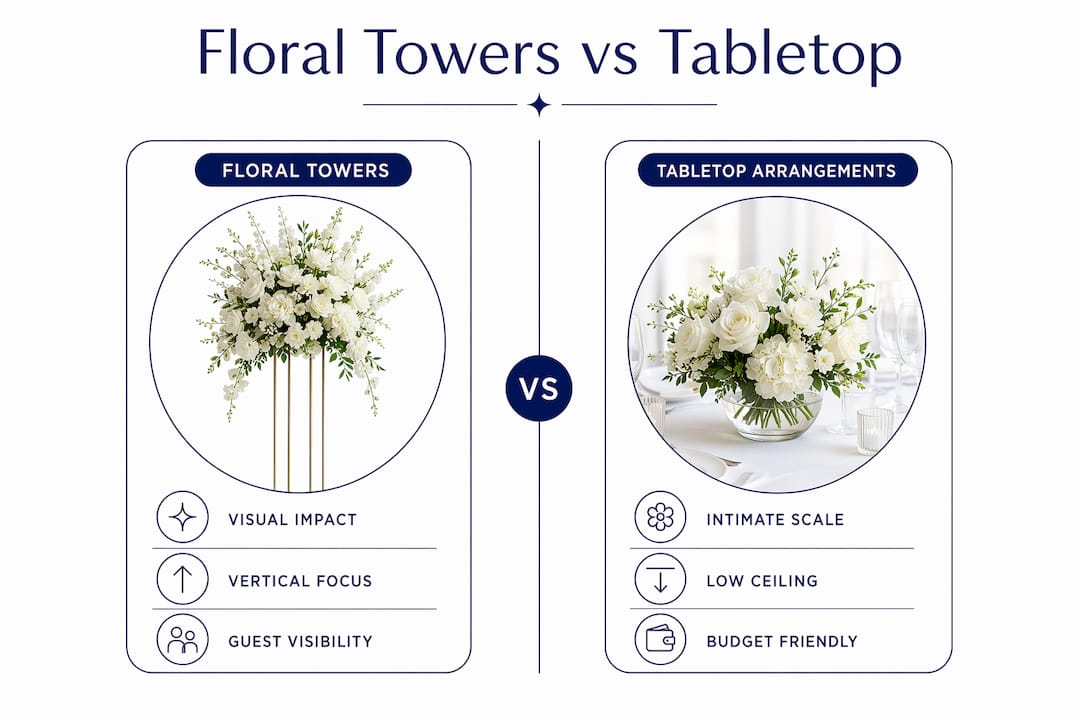
The contextual appropriateness of floral towers is vital. Size, style, and scent must suit the venue and event type. A 2-metre tower of heavily scented lilies in a small, enclosed dining room creates discomfort rather than delight. The same tower in a high-ceilinged ballroom becomes a signature moment.
Tabletop arrangements remain the right choice for intimate dinners, low-ceilinged venues, and events where budget is the primary constraint. Towers are the right choice when you need to define zones, create photography moments, or give a large venue a sense of human scale and warmth.
What are creative flower decor ideas for event towers?
The most memorable event tower decoration ideas share one quality: they feel specific to the occasion rather than generic. Personalisation is what separates a striking installation from a forgettable one.
- Seasonal blooms: Use flowers that are naturally in season for the event date. British summer weddings suit garden roses, sweet peas, and lavender. Autumn corporate events suit dahlias, amaranthus, and copper beech foliage. Seasonal choices reduce cost and improve freshness.
- Brand colour integration: For product launches and corporate events, match tower blooms precisely to brand colours. Pantone-matched florals are achievable with dyed blooms and careful variety selection, and they photograph beautifully against branded backdrops.
- Mixed fresh and faux elements: Combining real blooms with high-quality artificial foliage extends the visual life of a tower and reduces the risk of wilting in warm venues. The key is using faux elements only for foliage and structural fill, keeping real flowers as the focal points.
- Silhouette shaping: The most photogenic towers have a clear silhouette: a dome, a cascade, or an asymmetric drape. Choose one silhouette per tower and commit to it. Mixed silhouettes read as unplanned rather than artistic.
- Champagne tower pairing: Positioning a floral tower directly beside a champagne tower with flowers creates a combined installation that is both functional and spectacular. The two elements share visual language and reinforce each other’s impact.
For wedding ceremonies, arched towers of white and green florals frame the couple without competing with them. For corporate galas, monochromatic towers in brand colours create a polished, intentional aesthetic. For product launches, oversized tropical towers signal boldness and confidence.
Key takeaways
Flower decorations in event towers deliver the greatest impact when treated as architectural features integrated early into event production, not as decorative afterthoughts.
| Point | Details |
|---|---|
| Architectural function | Floral towers define zones and guide guest movement, functioning as spatial infrastructure rather than mere decoration. |
| Psychological impact | Research confirms flowers reduce stress and influence mood; colour and structure choices directly affect guest wellbeing. |
| Early integration is critical | Coordinating floral towers with lighting, staging, and logistics from the outset prevents costly conflicts and improves results. |
| Personalisation drives impact | Seasonal blooms, brand colours, and deliberate silhouette shaping distinguish memorable towers from generic installations. |
| Scale must match venue | Tower height, scent intensity, and structural complexity must suit the venue size and event type to avoid negative effects. |
Why i think most planners underestimate floral towers
Having worked alongside event teams at weddings, corporate galas, and product launches across the UK, the pattern I see most often is this: flowers are the last thing confirmed and the first thing compromised when budgets tighten. That is the wrong order of priorities, and the results show.
The events that genuinely stop guests in their tracks are the ones where the florist was in the room during the initial venue walkthrough. Not after the AV team had claimed every power point and the caterers had locked in the table plan. At that early stage, a floral tower is not just a decoration. It is a decision about where guests look, where they gather, and what they photograph. Those are not decorative decisions. They are spatial ones.
I have also seen planners choose low centrepieces across the board to save money, only to spend the same amount on printed signage and additional lighting to compensate for the lack of visual anchors. A single well-placed floral tower does the work of three separate décor elements. The importance of floral designs as functional infrastructure is genuinely undervalued in most event budgets.
My honest recommendation: allocate your floral budget to two or three statement towers rather than ten modest tabletop arrangements. The room will feel more considered, guests will remember it, and the photographs will be worth sharing. That is the return on investment that matters.
— Darren
Add floral magic to your next tower hire with Champagnetowerhire
If you are planning an event where visual impact and guest experience matter, Champagnetowerhire offers bespoke tower hire packages that combine the drama of a champagne tower with the beauty of professional floral decoration. Every installation is fully staffed, structurally engineered, and customised to your event’s colour palette and theme. Whether you are organising a wedding, a corporate gala, or a private celebration, the team handles everything from armature construction to final styling. Explore luxury tower hire options across the UK and get an instant quote today. For detailed inspiration, browse the champagne tower examples gallery to see floral and tower combinations in action.
FAQ
What is a floral tower in event design?
A floral tower is an elevated flower installation built on an armature or stand, designed to create a vertical focal point at key zones within an event space such as ceremony arches, head tables, or room entrances.
Why are flower towers better than tabletop arrangements for large venues?
Floral towers are visible from all guest positions across a large room, whereas tabletop arrangements are only seen by nearby guests. Towers also guide movement and create photography moments that low arrangements cannot achieve.
How early should floral towers be planned in event production?
Floral towers should be briefed and confirmed at the same time as AV, lighting, and staging teams. Late additions risk conflicts with rigging, furniture placement, and power supplies that are difficult to resolve on the day.
Do flower towers work for corporate events as well as weddings?
Floral towers are highly effective at corporate events, particularly product launches and galas, where they create photogenic backdrops that generate organic social media content and reinforce brand identity through colour-matched blooms.
What flowers work best in event towers?
Structural blooms like roses, dahlias, and peonies hold their form well in tall installations. Trailing elements like jasmine, amaranthus, and ivy add movement. Avoid heavily scented varieties like lilies in enclosed spaces, as concentrated fragrance can cause discomfort.


