

TL;DR:
- Tower pouring involves cascading champagne into a pyramid of coupe glasses, creating a visually stunning centerpiece. Proper construction, chilled champagne, and a designated pourer ensure a safe and impressive display at events. It is best reserved for a special moment, such as transitioning from dinner to dancing, to maximize its impact.
Tower pouring is defined as the technique of pouring champagne into the top glass of a stacked pyramid of coupe glasses, allowing it to cascade naturally downwards to fill every tier below. The industry term for this display is a champagne tower, and the pouring moment is its centrepiece. A standard 4-tier tower requires around 30 coupe glasses and 3–4 bottles of champagne. For event organisers and couples planning weddings or special occasions, tower pouring is one of the most photographed and celebrated beverage moments available. Champagnetowerhire specialises in creating exactly these displays across the UK.
What is tower pouring and how does it work?
Tower pouring is the act of steadily pouring champagne into the apex glass of a coupe pyramid so that the liquid overflows and fills each successive tier. The technique relies on physics as much as showmanship. As the top glass fills and overflows, surface tension and gravity guide the champagne into the glasses below, creating a continuous, glittering cascade. One standard bottle fills approximately 8 coupe glasses, so quantity planning is straightforward once you know your glass count. The result is a living, moving centrepiece that no static floral arrangement can replicate.
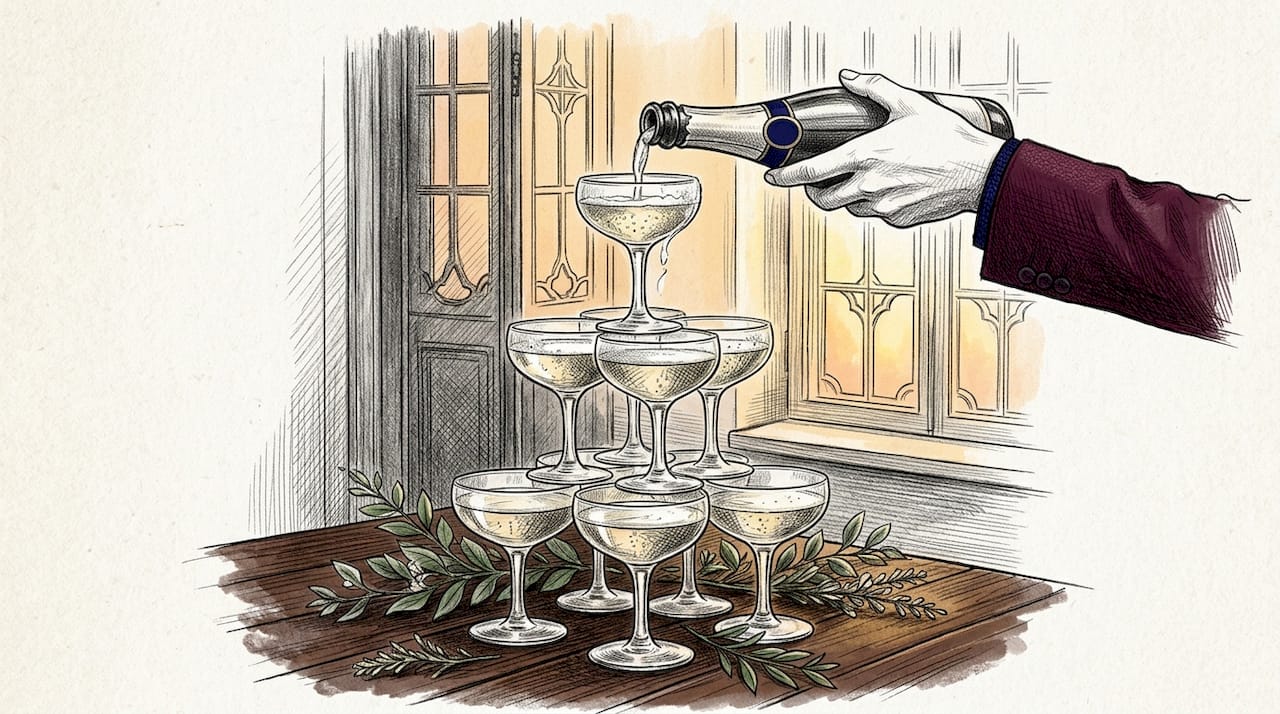
The appeal goes beyond aesthetics. Tower pouring has become an increasingly popular Instagrammable wedding moment, used to mark the transition from the wedding breakfast to the evening celebration. Guests gather, phones appear, and the room holds its breath. That shared anticipation is the real value of the technique.
How is a champagne tower constructed?
Building a stable champagne tower follows a clear sequence. Rushing any stage increases the risk of collapse, so patience at each step pays off.
- Choose the right glassware. Coupe glasses provide the base-to-rim stability that flutes cannot. Their wide, shallow bowls sit flush against each other, creating a locked, pyramid-like structure.
- Select a level, sturdy surface. A trestle table or dedicated plinth works well. Any surface wobble at this stage becomes a serious hazard once the tower is loaded with liquid.
- Build the base layer. Arrange the largest number of glasses in a tight square or rectangle. For a 4-tier tower, the base typically holds 16 glasses arranged in a 4×4 grid.
- Add each successive tier. Centre each new layer precisely over the gaps in the layer below. A 4-tier tower progresses from 16 glasses at the base to 9, then 4, then 1 at the apex.
- Conduct a dry run. Dry running the tower without liquid checks structural alignment and reveals any unstable glasses before the event begins.
- Prepare backup glasses. Keep 10–20% extra glasses on hand. Minor breakages happen, and having replacements avoids last-minute panic.
A 4-tier tower uses approximately 30 glasses. Scale up to 5 tiers and that number rises considerably, requiring more champagne and more setup time. A 55-glass tower needs 10–12 bottles to fill completely.
Pro Tip: Always build the tower at least 30 minutes before guests arrive. This gives you time to spot and correct any instability without an audience watching.
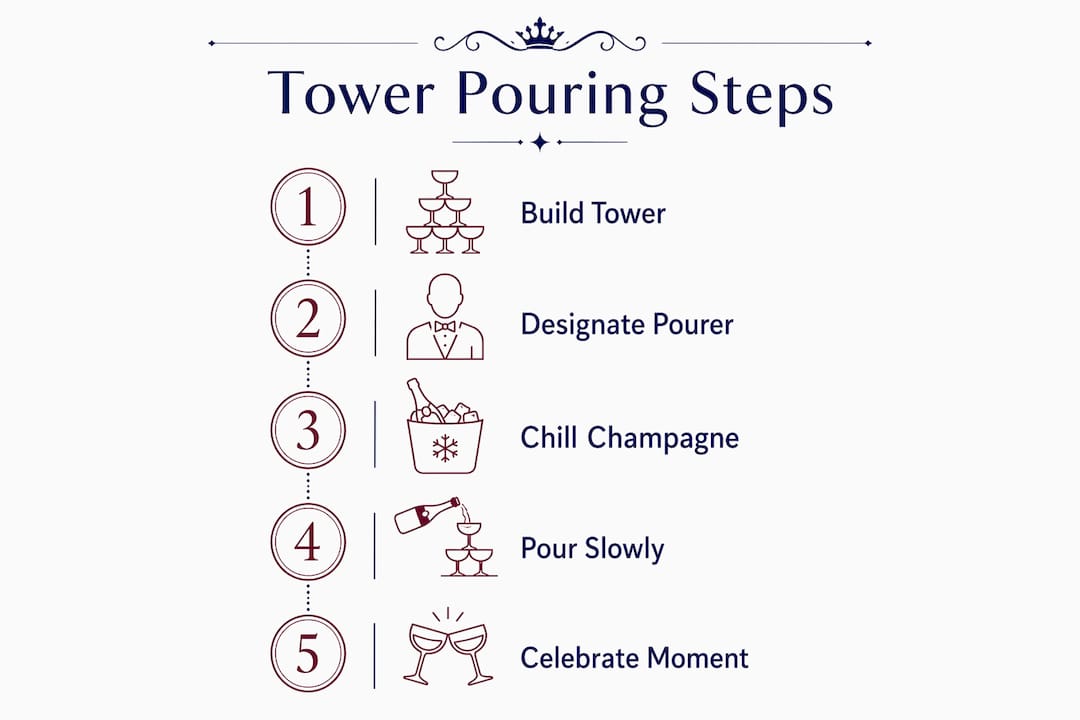
What is the technique for pouring champagne successfully?
The tower pouring method succeeds or fails on a handful of controllable factors. Get these right and the cascade is breathtaking. Get them wrong and you have a very expensive puddle.
- Temperature matters above all else. Well-chilled champagne minimises foaming and produces a clean, steady cascade. Chill bottles in a two-thirds ice, one-third water bath rather than a dry ice bucket for even cooling.
- Pour into the apex glass only. Direct the bottle at the single top glass and nowhere else. The champagne finds its own way down.
- Pour slowly and steadily. Pouring too quickly causes overflow and waste before the lower tiers fill. A controlled, unhurried pour gives the cascade time to settle into each layer.
- Do not stop prematurely. Stopping mid-pour leaves the bottom tiers empty and the display unfinished. Commit to the pour and have enough bottles ready to continue.
- Use magnum bottles where possible. A magnum delivers a consistent, uninterrupted flow that single bottles cannot always sustain, particularly for larger towers.
The tower pouring technique also benefits from a designated pourer. Event professionals recommend appointing a ‘Tower Master’, a single person responsible for the pour, to maintain aesthetic consistency and prevent spills.
Pro Tip: Tilt the bottle at a 45-degree angle and pour against the inner rim of the apex glass rather than directly into the centre. This reduces splashing and keeps the cascade smooth.
What practical considerations should event organisers observe?
Safety and logistics are as important as the spectacle itself. A poorly planned tower setup creates real risks for guests and staff alike.
- Use trained personnel for setup and breakdown. UK best practice in 2026 recommends trained staff for all champagne tower builds. DIY attempts, particularly for towers above 3 tiers, carry significant collapse risk.
- Confirm the surface is level and load-bearing. Champagne towers are heavy and require a sturdy, level surface. A slight tilt that looks harmless before pouring becomes dangerous once liquid weight is added.
- Allow adequate perimeter space. Guests will crowd around the tower for photographs. Build a clear zone of at least one metre around the base to prevent accidental knocks.
- Plan for breakages and spills. Minor breakages are part of the tower pouring process. Have a spill kit and replacement glasses within arm’s reach of the setup area.
- Factor in setup time. Interlocking systems can be assembled in 5–10 minutes. Real glass stacks take considerably longer. Build this into your event timeline using a champagne tower timeline to avoid rushing on the day.
Event professionals strongly discourage DIY champagne towers for large-scale events. The combination of glass, liquid, and excited guests is a recipe for mishap without professional coordination.
For organisers planning a full event programme, pairing the tower with complementary elements such as florals or fruit adds visual depth. The champagne towers with flowers approach is particularly popular at weddings, where fresh blooms woven around the base create a truly bespoke display. You can also find inspiration in festive event planning guides that cover the broader context of celebratory traditions.
How does tower pouring compare to other beverage displays?
Tower pouring is not the only way to present champagne dramatically. Understanding where it excels helps you choose the right format for your event.
| Feature | Tower pouring | Champagne wall |
|---|---|---|
| Visual centrepiece moment | Single, timed spectacle | Static display throughout event |
| Guest interaction | Shared anticipation during pour | Self-service throughout |
| Photography opportunity | One peak moment | Continuous backdrop |
| Setup complexity | High, requires trained staff | Moderate |
| Ideal event scale | 50–200 guests | Any scale |
| Customisation | Tier count, glassware, florals | Bottle selection, branding |
Tower pouring wins on drama. No other beverage display creates a single, shared moment that the entire room experiences together. A champagne wall is beautiful and practical, but it does not stop conversation the way a cascade does.
A 4–5 tier tower balances visual impact with practicality at most UK weddings and celebrations. Towers beyond 5 tiers require step-ladder access for the pour and become logistically complex. For most couples, a well-executed 4-tier display is the sweet spot between spectacle and manageability.
The advantages of tower pouring are most pronounced at seated receptions where a defined ‘moment’ marks a transition in the event. Corporate dinners, anniversary galas, and wedding breakfasts all benefit from this structure. Outdoor garden parties can also work well, with the added benefit that any spills are easier to manage on grass or paving.
Key takeaways
Tower pouring is the most visually dramatic beverage technique available at events, and its success depends entirely on preparation, the right glassware, and a trained pourer.
| Point | Details |
|---|---|
| Coupe glasses are non-negotiable | Their wide, shallow bowls create the stability that makes a pyramid structure possible. |
| Chill champagne correctly | A two-thirds ice, one-third water bath produces the right temperature for a clean cascade. |
| Appoint a Tower Master | One designated pourer maintains consistency and prevents spills during the pour. |
| Plan quantities carefully | A 4-tier tower needs 30 glasses and 3–4 bottles; a 55-glass tower needs 10–12 bottles. |
| Professional setup is the safest choice | Trained staff reduce collapse risk and manage the full setup and breakdown process. |
Why I think tower pouring deserves its place at every wedding
I have watched a lot of champagne towers go up and come down over the years. The ones that land perfectly share one thing: nobody rushed them. The couples who try to squeeze the tower pour into a five-minute gap between courses almost always end up with a half-filled display and a slightly damp tablecloth.
My honest advice is to treat the tower pour as a headline act, not an interval. Give it a proper slot in your event timeline, brief your guests that it is coming, and let the anticipation build. The room goes quiet in a way that even the best speeches rarely achieve.
I also think the ‘celebratory chaos’ aspect is underrated. A small spill, a glass that clinks a little too enthusiastically, a guest who gasps at the wrong moment. These are not failures. They are the texture of a real celebration. The couples who embrace that spirit always seem to enjoy the moment more than those who treat it as a performance to be executed flawlessly.
On tier size, I consistently recommend 4 tiers for most UK weddings. It is tall enough to be genuinely impressive, manageable enough for a single pourer, and practical enough that your venue will not need a structural survey before agreeing to it. Go bigger only if you have the staff and the space to do it properly.
— Darren
How Champagnetowerhire brings tower pouring to life
Champagnetowerhire provides fully staffed champagne tower hire across the UK, covering everything from the initial build to the final pour and breakdown. Every display is constructed by trained professionals who understand both the structural requirements and the theatre of the moment. Whether you are planning an intimate wedding breakfast or a large-scale gala, Champagnetowerhire offers bespoke tower displays tailored to your guest count, venue, and aesthetic. Optional additions including fresh flowers and seasonal fruit take the display further. Visit Champagnetowerhire to get an instant quote and see the full range of luxury tower options available for your event.
FAQ
What glasses do you need for tower pouring?
Coupe glasses are the correct choice for tower pouring. Their wide, shallow bowls provide the base-to-rim contact needed to build a stable pyramid structure.
How much champagne does a tower pour require?
A 4-tier tower using approximately 30 glasses needs 3–4 bottles of champagne. A larger 55-glass tower requires 10–12 bottles to fill completely.
Is tower pouring safe to do yourself?
Event professionals discourage DIY tower pouring for anything above 3 tiers. Trained staff significantly reduce the risk of collapse, spills, and breakages.
What is the best champagne temperature for tower pouring?
Champagne chilled in a two-thirds ice, one-third water bath reaches the ideal temperature for a clean cascade with minimal foaming.
When in an event should the tower pour take place?
Tower pouring works best as a defined transition moment, such as the move from a wedding breakfast to the evening reception, when all guests are gathered and attentive.


