

TL;DR:
- Building a stable champagne tower requires precise engineering and the use of wide coupe glasses.
- Proper planning, expert setup, and safety measures are essential for a flawless and memorable display.
- A single, well-executed tower offers greater visual impact and guest engagement than multiple smaller towers.
Most couples assume a champagne tower simply involves stacking glasses and pouring fizz. The reality is far more nuanced. A truly jaw-dropping tower requires precise structural knowledge, careful logistics, and a sharp eye for design. Get it right, and you create a breathtaking centrepiece that stops guests in their tracks and fills your wedding album with images you will cherish forever. Get it wrong, and you risk a very expensive, very public mishap. This guide walks you through everything: from the anatomy of a stable tower and choosing the right size for your guest list, to customisation ideas and the safety measures that separate a flawless display from a disaster.
Table of Contents
- What makes a champagne tower the ultimate reception statement?
- The essential anatomy: Building a stable and stunning champagne tower
- Timeline and logistics: Flawless execution for memorable moments
- Scaling for your guest list: Choosing the perfect tower size
- Customise your luxury: Design ideas, safety, and avoiding DIY disasters
- Why less is more: What most couples get wrong about champagne towers
- Elevate your reception: Bring the champagne tower dream to life
- Frequently asked questions
Key Takeaways
| Point | Details |
|---|---|
| Stability over height | Focus on level, secure stacking and quality coupe glasses for a stunning and safe champagne tower. |
| Professional setup pays off | Hiring specialists prevents mishaps and creates a flawless centrepiece for your luxury wedding. |
| Plan for your guest list | Select the right tower tier and champagne quantity by matching the display size to your celebration’s headcount. |
| Make it your own | Customise with LED, florals, or personal theming to elevate your champagne tower’s luxury impact. |
What makes a champagne tower the ultimate reception statement?
There is something genuinely theatrical about a champagne tower. The moment fizz cascades from the top glass downwards, the room collectively holds its breath. It is a spectacle that photographs beautifully, signals pure celebration, and instantly elevates the atmosphere of any reception.
Champagne towers have a rich history stretching back to 1920s France, where they became synonymous with glamour and excess. Today, they are firmly embedded in luxury wedding culture across the UK. In fact, champagne towers feature in over 80% of elegant UK weddings as a focal point and for memorable photos. That statistic alone tells you how central they have become to the modern luxury reception.
“A champagne tower is not just a drink station. It is a declaration that this wedding is something extraordinary.”
The classic design uses coupe glasses, those wide, shallow bowls that allow champagne to flow freely from tier to tier. Flutes simply do not work for this purpose; their narrow openings prevent the cascade effect entirely. Champagne towers are pyramid structures of coupe glasses, now featured in over 80% of elegant UK weddings.
Key reasons couples choose a champagne tower as their reception centrepiece:
- Wow factor: A single, well-executed tower commands the entire room and creates a natural focal point for photography.
- Timing flexibility: The pour can align with the grand entrance, the toast, or the first dance announcement.
- Guest engagement: Everyone gathers instinctively, creating a shared, communal moment of celebration.
- Visual impact: A tall, gleaming pyramid of glasses is simply more impressive than any floral arrangement or table display.
One important piece of advice: resist the temptation to scatter multiple smaller towers around the venue. A single, spectacular wedding champagne tower hire display creates far more impact than several modest ones. Concentration of spectacle is always more powerful than dilution. If you want to make your wedding memorable, one breathtaking centrepiece is the answer.
The essential anatomy: Building a stable and stunning champagne tower
Having explored the allure and symbolism, let’s demystify the technical structure that brings towers to life.
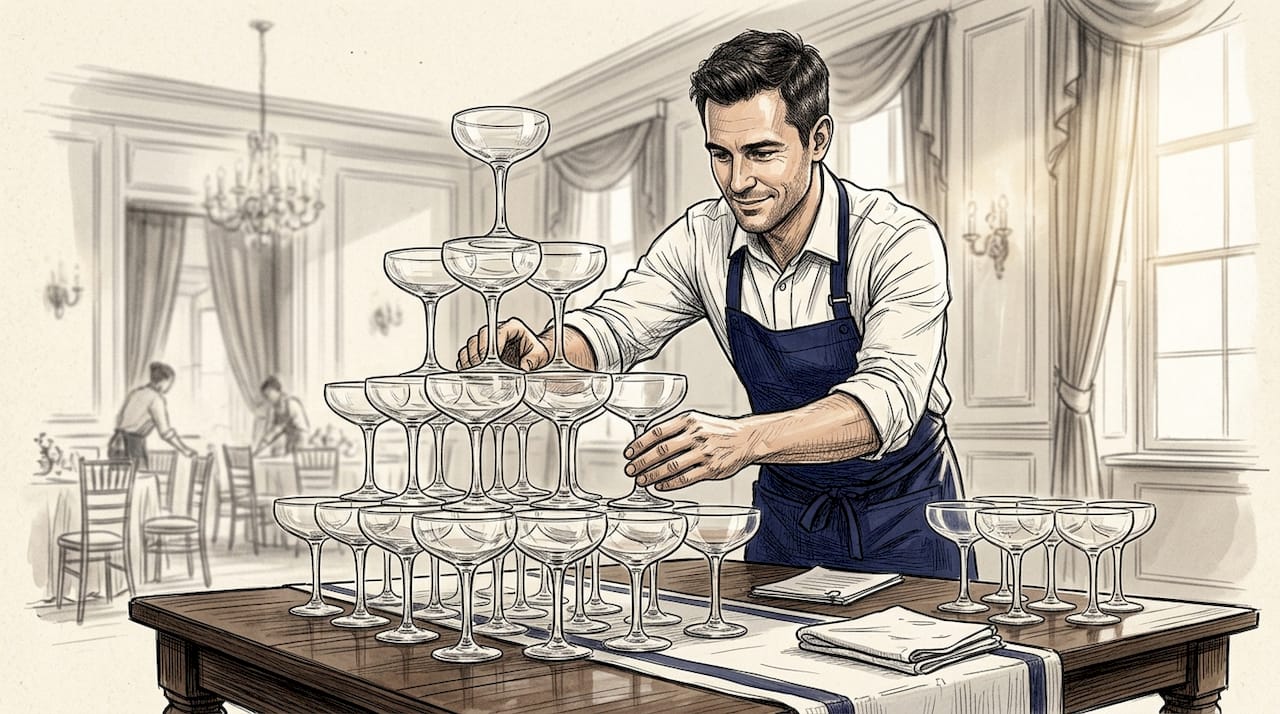
The pyramid arrangement is everything. Each glass sits in the gap between two glasses on the row below, creating a diamond pattern that distributes weight evenly. This is not guesswork; it is engineering. Every glass must touch its neighbours for stability, and every tier must be perfectly centred before the next is added.
Use wide coupe glasses (180 to 210ml) and stack in a tight pyramid, centring each on the spaces between lower glasses. This size range is critical. Glasses that are too small will not hold enough champagne to cascade properly. Glasses that are too large become unstable at height.
Glass comparison for champagne towers:
| Glass type | Shape | Suitable for towers? | Cascade effect |
|---|---|---|---|
| Coupe | Wide, shallow bowl | Yes | Excellent |
| Flute | Tall, narrow | No | None |
| Tulip | Tapered, medium | No | Poor |
The surface beneath the tower matters enormously. Stability and level surfaces matter more than height; professionals advise against DIY at luxury events. Even a slight tilt in the base table can cause the entire structure to shift under the weight of champagne. Always use a reinforced table with a non-slip surface, and check the level with a spirit level before placing a single glass.
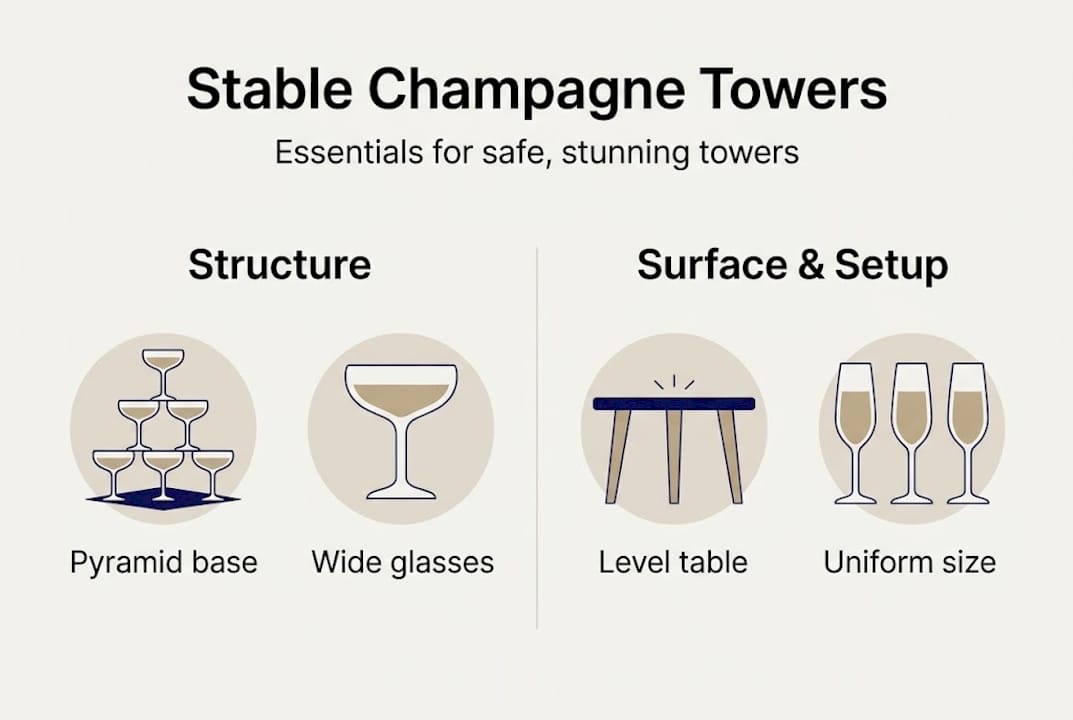
Uniform glass size is non-negotiable. Mixing glass sizes, even slightly, creates uneven weight distribution and unpredictable champagne flow. Every glass in your tower must come from the same batch.
Pro Tip: Before adding any champagne, gently tap the base of the tower with one finger. If you feel any wobble or hear glasses shifting, stop and re-set the structure. This simple test takes ten seconds and can prevent a catastrophic collapse.
For expert guidance on the full structural process, plan your champagne tower with professionals who understand every nuance of stable construction.
Timeline and logistics: Flawless execution for memorable moments
Once you have selected the right structure, meticulous planning ensures your tower dazzles on the day.
The logistics of a champagne tower are more involved than most couples anticipate. Timing is everything, and the difference between a smooth, elegant pour and a chaotic scramble often comes down to planning that begins weeks in advance.
Book 8 to 10 weeks ahead, arrange a site visit at 4 to 6 weeks out, and allow 45 to 120 minutes for setup with 2 to 4 professionals. Keep a 1 metre safety zone around the tower at all times.
Champagne tower logistics at a glance:
| Task | Timing |
|---|---|
| Book your tower hire | 8 to 10 weeks before the wedding |
| Site visit and venue check | 4 to 6 weeks before |
| Setup begins on the day | 45 to 120 minutes prior to guests arriving |
| Safety zone established | 1 metre clear perimeter |
| Pour scheduled | Toast or grand entrance |
Here is a step-by-step logistics checklist to keep you on track:
- Confirm your booking and guest numbers with your tower hire specialist.
- Arrange a site visit to assess floor levels, access points, and power for any LED features.
- Agree on staffing numbers: large towers need at least 3 to 4 professionals for safe setup.
- Position the tower away from high-traffic areas and well clear of children’s seating.
- Brief your photographer on the exact pour moment so they are positioned and ready.
- Align the pour for toasts or the grand entrance and gather guests promptly, as fizz flattens quickly in coupes.
For a full breakdown of what to expect from professional setup, the champagne tower hire guide covers every detail. Couples planning London receptions can also explore luxury champagne tower hire options tailored to city venues.
Scaling for your guest list: Choosing the perfect tower size
With logistics mapped out, the next step is tailoring the spectacle to your unique guest numbers and celebration scale.
Choosing the wrong size tower is one of the most common mistakes couples make. Too small, and it looks underwhelming against a grand venue. Too large, and you risk instability and wasted champagne. The right size is determined by your guest count and the visual scale of your reception space.
A 4-tier tower holds 30 glasses and suits fewer than 50 guests. A 6-tier tower holds 90 glasses and works beautifully for 75 to 100 guests. For 140 to 200 or more guests, a 7 to 10-tier tower creates the truly grand statement your venue deserves. For a 90-glass tower, plan for 12 to 15 bottles of champagne, allowing approximately 150ml per glass plus a 20% buffer.
Key sizing guidelines to keep in mind:
- 4-tier tower: 30 glasses, ideal for intimate weddings of up to 50 guests.
- 6-tier tower: 90 glasses, perfect for 75 to 100 guests.
- 7 to 10-tier tower: 140 glasses or more, suited to grand receptions of 140 to 200+ guests.
- Bottle calculation: Allow roughly 1 bottle per 5 to 8 glasses, then add a 20% buffer for spillage and top-ups.
Over 80% of champagne tower mishaps stem from inadequate setup or an incorrectly sized tower for the venue and guest count.
A single tall tower is always safer and more photogenic than multiple smaller ones. Height creates drama. It draws the eye upward and gives photographers a genuinely spectacular composition to work with. Browse stunning champagne tower displays for inspiration, or explore the lavish options available through Knightsbridge champagne tower hire for truly opulent receptions.
Pro Tip: Always prepare at least six spare glasses and one backup bottle of champagne. Accidents happen, and having reserves on hand means your team can respond instantly without interrupting the moment.
Customise your luxury: Design ideas, safety, and avoiding DIY disasters
Finally, to truly personalise your wedding and avert disasters, explore what takes champagne towers from generic to show-stopping and safe.
A champagne tower does not have to be just glass and fizz. The most memorable towers are the ones that reflect the couple’s personality and the overall aesthetic of the wedding. Think warm LED uplighting that makes the glasses glow gold, bespoke florals woven around the base, or monogrammed elements that tie the display into your wedding stationery.
Bespoke theming with LED lighting, florals, and branding elevates the luxury feel and ensures your tower is a genuine extension of your wedding design, not an afterthought.
Safety becomes especially important in historic or unusual venues. Uneven flagstone floors, listed building restrictions, and delicate surfaces all require specialist handling. Historic venues need floor underlays; large towers can collapse if placed on uneven ground or assembled without professional expertise. Food-safe stabilising gel can be used on particularly challenging surfaces.
Here is how to avoid the most common DIY pitfalls:
- Never attempt a tower of more than 4 tiers without professional assistance.
- Always check the venue floor for level before setup begins.
- Use food-safe gel or rubber matting under the base table on uneven surfaces.
- Keep all electrical elements for LED features away from any liquid zones.
- Conduct a full trial pour before guests arrive to check flow, stability, and timing.
“The most spectacular towers we have seen are always the ones where every detail was planned in advance and nothing was left to chance.”
Pro Tip: Schedule a private trial pour at least one hour before guests enter the reception space. This lets your team check the cascade, adjust any glass positions, and confirm that the champagne flows evenly from top to bottom. For full guidance on plan a bespoke tower that reflects your vision perfectly, speak to specialists early in your planning process.
Why less is more: What most couples get wrong about champagne towers
After exploring customisation and expert guidance, it is worth stepping back and challenging a very common assumption.
Many couples believe that bigger automatically means better. They consider ordering two or three towers, or pushing for the tallest possible structure regardless of venue size. In our experience, this approach almost always backfires. Multiple towers split the guests’ attention, dilute the moment, and increase the risk of something going wrong.
Wedding photographers and event planners consistently report that a single, perfectly positioned tower creates a far stronger emotional response than several scattered displays. The collective gasp when the champagne cascades is a once-in-the-evening moment. Spreading it across multiple towers turns a singular memory into a forgettable routine.
Investing your budget in one expertly built, beautifully themed tower with professional staffing will always outperform a DIY approach or a quantity-over-quality strategy. The photos are better, the guests are more engaged, and the safety record is incomparably stronger. A memorable wedding champagne tower is always about precision and focus, not excess.
Final Pro Tip: Schedule your pour for the exact moment when every guest is gathered, cameras are raised, and the room is at its most electric. It is a fleeting, unrepeatable moment, and it deserves to be treated as such.
Elevate your reception: Bring the champagne tower dream to life
Ready to create a wedding moment your guests will never forget? Here is how to make it happen with specialist support.
At Champagne Tower Hire, we specialise in turning your vision into a flawless, breathtaking reality. From intimate 4-tier displays to towering 10-tier showstoppers, our team manages every detail: structural setup, bespoke styling, staffing, and safety. Explore our full range of wedding champagne tower hire options and find the perfect fit for your celebration. For a complete overview of what a professional setup involves, our luxury champagne tower setup guide is the ideal starting point. Get in touch today to secure your date and let us create something truly extraordinary for your reception.
Frequently asked questions
How many bottles of champagne do I need for a wedding tower?
For a 6-tier, 90-glass tower, you will need 12 to 15 bottles, allowing around 150ml per glass plus a 20% buffer for spillage and top-ups.
Can I set up a large champagne tower myself?
DIY is strongly discouraged for large or luxury towers; professionals advise against it due to the very real risk of collapse and the safety implications at a high-end event.
What kind of glasses do I need for a champagne tower?
Always choose wide coupe glasses in the 180 to 210ml range for stability and the classic cascade effect. Flutes are entirely unsuitable for tower construction.
When should the champagne tower pour happen during the wedding?
Time your pour for the toasts or grand entrance, and gather guests promptly because the fizz fades quickly in the wide coupe glasses.
What are the safety considerations for champagne towers at historic venues?
Historic venues require floor underlays and careful placement; always confirm the venue’s floor weight limits and have a spill management plan in place before setup begins.


