

TL;DR:
- Champagne towers create a dramatic visual centerpiece using fewer bottles, while traditional toasts foster guest participation and emotional connection. The choice depends on event scale, logistics, and desired atmosphere, with combining both being a popular and effective approach. Proper timing and planning enhance guest experience, blending spectacle with inclusivity for unforgettable celebrations.
A champagne tower is defined as a pyramid of stacked coupe glasses filled by a single cascade pour from the top, creating a dramatic, photogenic spectacle at weddings and upscale events. The towers versus traditional toasts debate is one of the most common decisions couples and event planners face when designing their celebration’s beverage moment. Traditional toasts, by contrast, involve passing champagne flutes to every guest so they can raise their glass in unison. Both approaches carry real weight in terms of visual impact, guest experience, and event flow. The right choice depends on your venue, guest count, timeline, and the atmosphere you want to create.
How do towers versus traditional toasts differ in guest experience?
Champagne towers and traditional toasts deliver entirely different emotional experiences. A tower is a scheduled showpiece, designed to stop the room and draw every eye to a single, breathtaking moment. A traditional toast is a shared ritual, pulling every guest into the celebration simultaneously.
The visual mechanics matter here. Coupe glasses are required for towers because their flat bases and interlocking design create the structural stability needed for stacking. Flutes, with their narrow rims, cannot stack safely. The cascade pour, where champagne flows from the top glass downward through each tier, is the defining visual moment of the tower format.
Traditional toasts use flutes precisely because they preserve carbonation and aroma longer. Coupe glasses cause champagne to go flat more quickly due to their wider surface area, which means tower guests should drink promptly after the pour. This is a practical nuance most couples do not consider until the day itself.
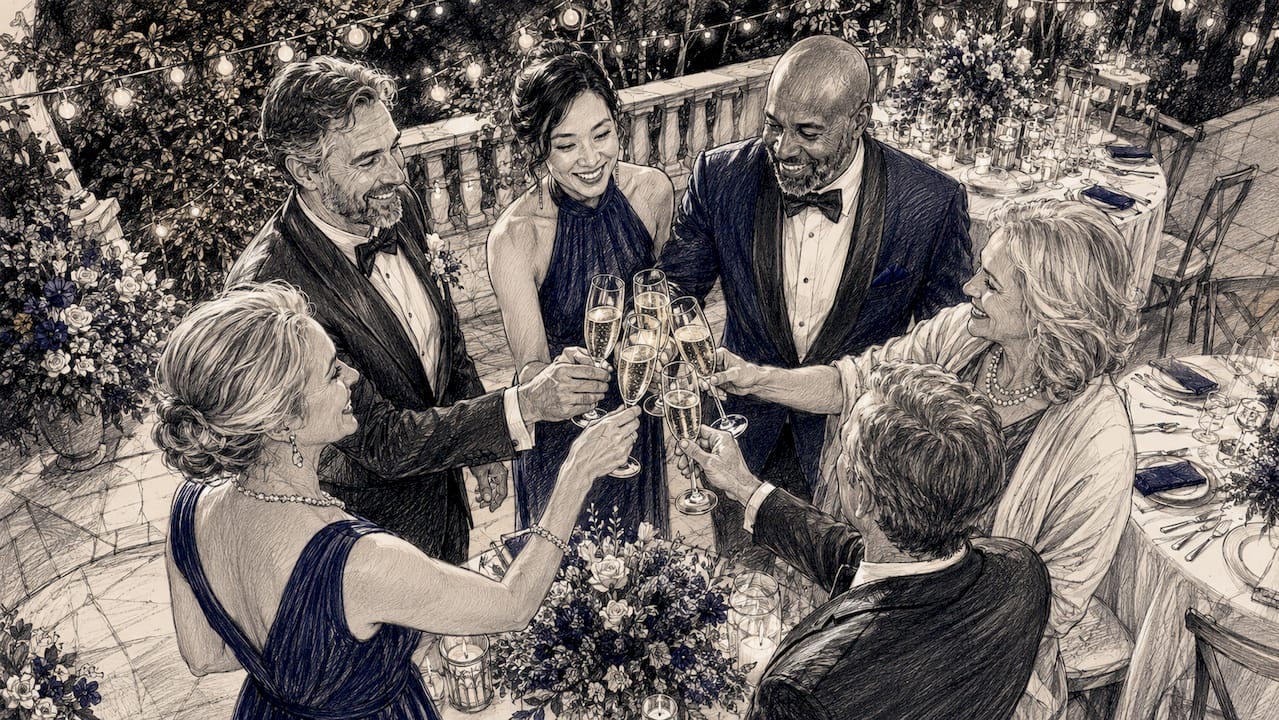
For guest engagement, towers create a spectator experience. Guests watch, photograph, and react. Traditional toasts create a participatory experience. Every person raises their glass at the same moment, which generates a collective emotional charge that towers simply cannot replicate.
Pro Tip: Schedule your champagne tower pour to coincide with your photographer’s best light and position. The cascade effect lasts only seconds, so brief your photographer in advance and agree on the exact signal to start pouring.
- Champagne towers: dramatic focal point, perfect photo moment, suits grand entrances or first dances
- Traditional toasts: inclusive, simultaneous, emotionally connective, suits speeches and intimate moments
- Glassware: coupes for towers, flutes for toasts, each affecting carbonation and drinking experience differently
- Timing: towers require a planned pause in proceedings; traditional toasts slot into the event timeline with minimal disruption
How do logistics and scale affect your choice?
The practical differences between these two formats are significant, and they often determine the decision more than aesthetics do. Towers require careful setup, dedicated table space, multiple identical coupe glasses, and experienced staff to build and pour safely. Traditional toasts require only pre-filled flutes and a signal to raise them.
Tower sizing follows a clear structure. Towers typically range from 3 to 8 tiers, with a 4-tier tower holding approximately 20 glasses being the most popular choice for weddings. The champagne consumption difference between the two formats is striking and directly affects your budget.
| Factor | Champagne Tower (4-tier, 20 glasses) | Traditional Toast (20 guests) |
|---|---|---|
| Champagne required | Approx. 3 bottles (cascade pour) | Approx. 6 bottles (full 7 oz pour) |
| Setup complexity | High: stacking, staffing, table space | Low: pre-filled flutes, quick pass |
| Guest count suitability | Best for 50–150 guests | Scales easily to 300+ guests |
| Event flow impact | Scheduled pause required | Minimal disruption |
| Staffing requirement | Dedicated tower attendant advised | Standard bar staff sufficient |
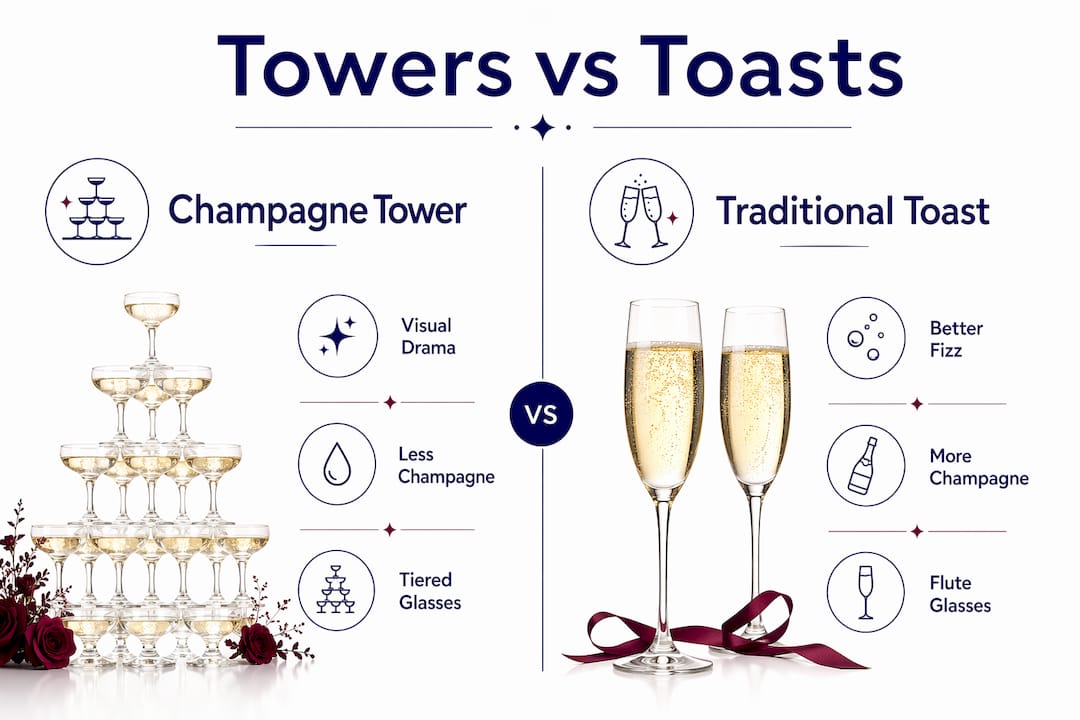
A 4-tier cascade pour uses approximately 3 bottles compared to 6 bottles for a full traditional pour across the same 20 glasses. That difference means towers are not only more theatrical but also more economical per glass served, provided guests are happy with a partial fill. For large weddings of 200 or more guests, traditional toasts are considerably easier to execute without logistical strain.
Venue considerations also play a role. Towers need a stable, level surface and sufficient ceiling clearance for taller builds. Outdoor events introduce wind and uneven ground as genuine risks. Acrylic towers are increasingly recommended by hire providers for outdoor settings because they offer the same elegance as glass with far greater safety margins.
Pro Tip: If your venue has a grand staircase or elevated platform, position your tower at the base for maximum sightlines. Every guest in the room should be able to see the cascade pour without craning their neck.
What style and atmosphere should guide your decision?
The comparison of toast styles is ultimately a question of what story you want your celebration to tell. Champagne towers evoke vintage glamour, Art Deco sophistication, and theatrical luxury. They reference the golden age of Gatsby-era parties and carry an inherent sense of occasion. Traditional toasts signal timeless formality and collective warmth.
Your event theme should drive this choice directly. A black-tie wedding at a grand country house suits a tower beautifully. An intimate garden ceremony with 40 guests is better served by a heartfelt, simultaneous toast where every person feels included. The champagne role at weddings extends beyond the drink itself; it is a symbol of celebration, and the format you choose amplifies that symbolism.
Styling options differ considerably between the two formats:
Champagne Tower Styling Pros:
- Flowers, strawberries, and gold-leaf garnishes can be added around the base for a bespoke look
- Towers become a centrepiece, reducing the need for additional table décor
- Acrylic or crystal glassware options allow you to match your colour palette
- The tower itself photographs beautifully in wide-angle shots, adding drama to your wedding album
Champagne Tower Styling Cons:
- Coupes go flat faster, so guests must drink quickly after the pour
- Requires advance planning and professional setup
Traditional Toast Styling Pros:
- Flutes preserve fizz and aroma, delivering a better drinking experience
- Personalised flutes with names or dates add a sentimental touch
- Works with any sparkling wine, from Veuve Clicquot to Taittinger to Nyetimber
Traditional Toast Styling Cons:
- Less visual impact; the moment passes quickly
- Relies heavily on the quality of the speech to create emotional resonance
Non-alcoholic sparkling juices and rosé alternatives work successfully in both formats, which is worth noting for events with guests who do not drink alcohol. Inclusivity should always factor into your beverage planning.
Which option offers better value and guest satisfaction?
Cost and guest satisfaction are closely linked, and the answer here is more nuanced than it first appears. Towers use less champagne per guest due to the cascade pour delivering a partial fill of approximately 3.5 oz per glass. Traditional toasts pour a full 7 oz per guest, doubling the bottle count for the same number of people. For a 20-person toast, that is the difference between 3 bottles and 6 bottles, a meaningful saving if you are serving premium labels.
Choosing the right champagne matters for both formats. Veuve Clicquot and Taittinger are popular choices for towers because their consistent carbonation handles the cascade pour well without excessive foaming. For traditional toasts, Nyetimber, the award-winning English sparkling wine, offers a compelling and locally sourced alternative that resonates with guests. You can explore the full range of options in this champagne selection guide from Champagnetowerhire.
Here are five ways to maximise value without compromising on style:
- Use the cascade pour for your tower to reduce champagne consumption by up to 50% compared to a full pour.
- Reserve premium labels like Veuve Clicquot for the tower itself and serve a quality prosecco for additional rounds.
- Hire your tower with glassware included to avoid purchasing coupe glasses outright, which can cost significantly more than a hire package.
- Opt for a 4-tier tower (20 glasses) as your display piece and supplement with passed flutes for guests not served by the tower.
- Brief your bar staff to pass flutes immediately after the tower pour so no guest feels left out of the toast moment.
Pro Tip: Combining both formats is increasingly popular in 2026. Use the tower as your visual centrepiece and photographic highlight, then follow immediately with passed flutes so every guest can join the toast. You get the drama and the intimacy in one sequence.
Creative wedding toast ideas that blend both approaches are worth exploring if you want the best of both worlds without doubling your budget.
Key takeaways
Champagne towers deliver unmatched visual drama and use less champagne per guest, while traditional toasts offer superior guest inclusivity, better carbonation, and simpler logistics for large events.
| Point | Details |
|---|---|
| Glassware determines format | Coupes are required for towers; flutes preserve fizz better for traditional toasts. |
| Towers use less champagne | A cascade pour needs approximately 3 bottles for 20 glasses versus 6 for a full pour. |
| Scale guides the decision | Traditional toasts suit guest counts above 150; towers work best for 50–150 guests. |
| Style signals matter | Towers evoke vintage glamour; traditional toasts signal collective warmth and formality. |
| Combining both is possible | Use a tower as the visual moment, then pass flutes so every guest can participate. |
Why i think the either/or debate misses the point
After working with couples and event planners across hundreds of celebrations, I have come to believe that framing this as a straight choice between towers and traditional toasts is the wrong starting point. The question is not which format is better. The question is what you want your guests to feel at that specific moment in your event.
Towers are extraordinary when they are placed correctly in the timeline. I have seen them land with genuine gasps from a room of 120 guests. I have also seen them fall flat when positioned awkwardly between speeches, with guests distracted and the pour going unnoticed. Timing is everything, and a poorly timed tower is worse than no tower at all.
Traditional toasts, on the other hand, are underrated. When a room of 200 people raises a glass in unison, the collective energy is something a tower simply cannot manufacture. The best speeches I have witnessed were paired with a traditional toast, and the emotional resonance lasted long after the fizz had gone.
My honest recommendation for 2026 is this: if your venue and budget allow, do both. Use the tower as your arrival or entrance moment, then follow with a traditional toast during the speeches. The two formats complement each other rather than compete. Couples who treat them as separate tools for separate emotional purposes always get more from their celebration than those who feel forced to choose one or the other.
The champagne tower setup process is more straightforward than most couples expect, particularly with professional hire support. Do not let logistics be the reason you miss out on one of the most memorable moments your event can offer.
— Darren
Make your celebration unforgettable with Champagnetowerhire
Whether you are drawn to the spectacle of a cascading tower or the timeless elegance of a traditional toast, Champagnetowerhire brings expert knowledge and premium equipment to every event. From bespoke 3-tier to 8-tier builds with fully staffed setups, to optional floral and strawberry garnishes, every detail is handled with care. Champagnetowerhire covers events across the UK and internationally, making it simple to add a genuinely show-stopping beverage display to your wedding or upscale celebration. Visit Champagnetowerhire to get your free instant quote and explore the full range of luxury tower hire options available for your event.
FAQ
What is the main difference between a champagne tower and a traditional toast?
A champagne tower is a stacked pyramid of coupe glasses filled by a cascade pour, creating a visual spectacle. A traditional toast involves passing flutes to all guests for a simultaneous raise-and-drink moment.
How many bottles of champagne does a tower use compared to a traditional toast?
A 4-tier tower with 20 glasses requires approximately 3 bottles for a cascade pour, while a full traditional pour for the same 20 guests uses approximately 6 bottles.
Can you use non-alcoholic drinks in a champagne tower?
Yes. Non-alcoholic sparkling juices and rosé alternatives work well in both towers and traditional toasts, making either format suitable for inclusive celebrations.
Which format suits larger weddings better?
Traditional toasts scale more efficiently for guest counts above 150, as towers require more setup and staffing that becomes complex at very large events.
Can you combine a champagne tower with a traditional toast at the same event?
Absolutely. Many couples in 2026 use the tower as a dramatic visual moment on arrival or at a key transition, then follow with passed flutes so every guest can join the formal toast during speeches.


