

TL;DR:
- Confirming guest numbers and service style is essential because they determine entire event planning, including licensing and staffing.
- A written license check and supplier briefing prevent costly mistakes, ensuring safety and smooth service flow.
Confirm your guest numbers and service style before anything else. Those two decisions shape every downstream choice: tower size, bottle count, staffing levels, and whether your venue needs a Temporary Event Notice (TEN) or already holds a premises licence. Once you have those locked in, brief your supplier against a written checklist so nothing is left to assumption on the day.
First three steps to take right now:
- Confirm your final (or best-estimate) guest count, including any children who will not be drinking alcohol.
- Decide your service style: fully staffed poured service, tray-pass arrivals, or a self-serve display with a staff presence for safety.
- Check your venue’s licence status. If the venue does not hold a premises licence covering your event, you or the venue will need a TEN under the Licensing Act 2003.
The single most costly mistake in luxury event beverage planning is leaving the licence question until the week before. Resolve it at the point of booking, not after you have signed a supplier contract.
Contact Champagnetowerhire as your UK specialist for champagne and prosecco tower hire once those three points are confirmed.
Table of Contents
- Your at-a-glance checklist for polished champagne-tower service
- How do you size a champagne tower and estimate quantities?
- UK licensing, safety and insurance: what you must check
- What staffing and service flow does a luxury tower need?
- How do styling and presentation lift a tower to a luxury experience?
- Contingency planning for live events: spillage, breakage and last-minute changes
- What should you ask your champagne-tower supplier?
- Cost drivers and a realistic planning timeline
- Key takeaways
- Why specialist suppliers make the real difference
- Champagnetowerhire: turnkey luxury towers for UK events
- Useful sources and further reading
Your at-a-glance checklist for polished champagne-tower service
Use this against every event before you brief a supplier or sign anything. The event drinks service guide from Champagnetowerhire covers many of these in more depth.
- Guest numbers: confirmed adult count, plus children for soft-drink planning.
- Service style: poured/staffed, tray-pass, or supervised self-serve.
- Licence status: premises licence confirmed with venue, or TEN applied for.
- Staffing: minimum staff ratios agreed with supplier (see Section 5).
- Glassware count: tower glasses plus a contingency float of at least 10%.
- Lighting and access: tower footprint mapped, power confirmed, sightlines clear.
- Contingency stock: spare bottles and glasses staged out of guest view.
- Teardown window: agreed with venue before the contract is signed.
Pro Tip: Consumption peaks hit hardest at arrival, immediately after speeches, and when evening entertainment begins. Schedule your highest staff coverage for those three windows, not evenly across the whole event.
Confirm the premises licence or TEN status directly with your venue coordinator in writing. Verbal assurances are not sufficient for a licensed event.
How do you size a champagne tower and estimate quantities?
Tower size maps roughly to tier count, and tier count maps to glass capacity. A standard coupe-glass tower uses approximately six glasses per tier, so a five-tier tower holds around 30 glasses. For a welcome pour on arrival, plan on one glass per adult guest; for a sustained evening service, consumption guidance suggests 1–2 alcoholic drinks per guest per hour, adjusted for event type and time of day.
| Tower size | Approx. glasses | Bottles required (75cl) | Suitable for |
|---|---|---|---|
| 3-tier | — | 3–4 bottles | Intimate gatherings, fewer guests |
| 5-tier | ~30 glasses | 5–6 bottles | Receptions, around 50 guests |
| — | — | 10–12 bottles | Large receptions, 100 or more guests |
| — | — | 15 bottles | Grand celebrations, 150 or more guests |
Sample calculation: 120 guests at an evening reception, two-hour champagne service. At one glass per guest for the arrival pour plus one refill across the evening, you need roughly 240 serves. A 75cl bottle yields approximately six standard coupe serves, so budget around 40 bottles as your working figure, before overage.
Pro Tip: Always add a 10–15% overage buffer. At a luxury event, running short mid-service is far more damaging to the guest experience than having a few bottles left over. Stage the contingency stock out of sight so the display always looks full.
UK licensing, safety and insurance: what you must check
The legal framework is clear. Under the Licensing Act 2003, serving or selling alcohol is a licensable activity in England and Wales. Most champagne tower hire scenarios fall into one of two categories: the venue holds a premises licence that covers your event, or you need a TEN.
A TEN covers events with fewer than 500 people and a maximum duration of 168 hours. It is the standard route for one-off private events at unlicensed venues.
When is a licence not required? If champagne is provided entirely free to guests with no linked ticket charge or hidden cost recovery, it may not constitute a retail sale under the Act. However, NCASS guidance notes that local authority interpretation varies, so always verify with your venue’s licensing team rather than assuming free provision is automatically exempt.
The S182 guidance also covers late-night refreshment and regulated entertainment, which may apply if your event runs past 11 PM.
Safety controls to confirm with your supplier:
- Tower base secured and load-bearing surface assessed before build.
- Staff trained in glass handling and spill response.
- Clear cordon plan if a glass breaks during service.
- Public liability insurance confirmed in writing.
For detailed drink display safety guidance, Champagnetowerhire publishes a dedicated resource for event planners.
What staffing and service flow does a luxury tower need?
The minimum staffing model depends on tower size and service style. As a practical baseline:
- Pour lead (1 per tower): manages the initial cascade, controls pour pace, and monitors glass levels throughout service.
- Safety marshal (1 per tower): maintains the cordon during the pour, watches for instability, and handles any breakage response.
- Floater/runner (1 per 50 guests): circulates with trays, collects empty glasses, and restocks from contingency.
- Event liaison (1 per event): communicates with the venue coordinator and adjusts service pace in real time.
For towers serving 100+ guests, add a second floater. For corporate events with formal table plans, consider upscale corporate drinks service formats that blend tower display with table wine service.
The ideal service flow runs in three phases: a welcome pour as guests arrive, a post-speech surge timed to the MC’s cue, and a steady refill cadence through the evening. Aligning staff presence with those peaks, rather than spreading coverage evenly, keeps the experience polished without inflating your staffing budget.
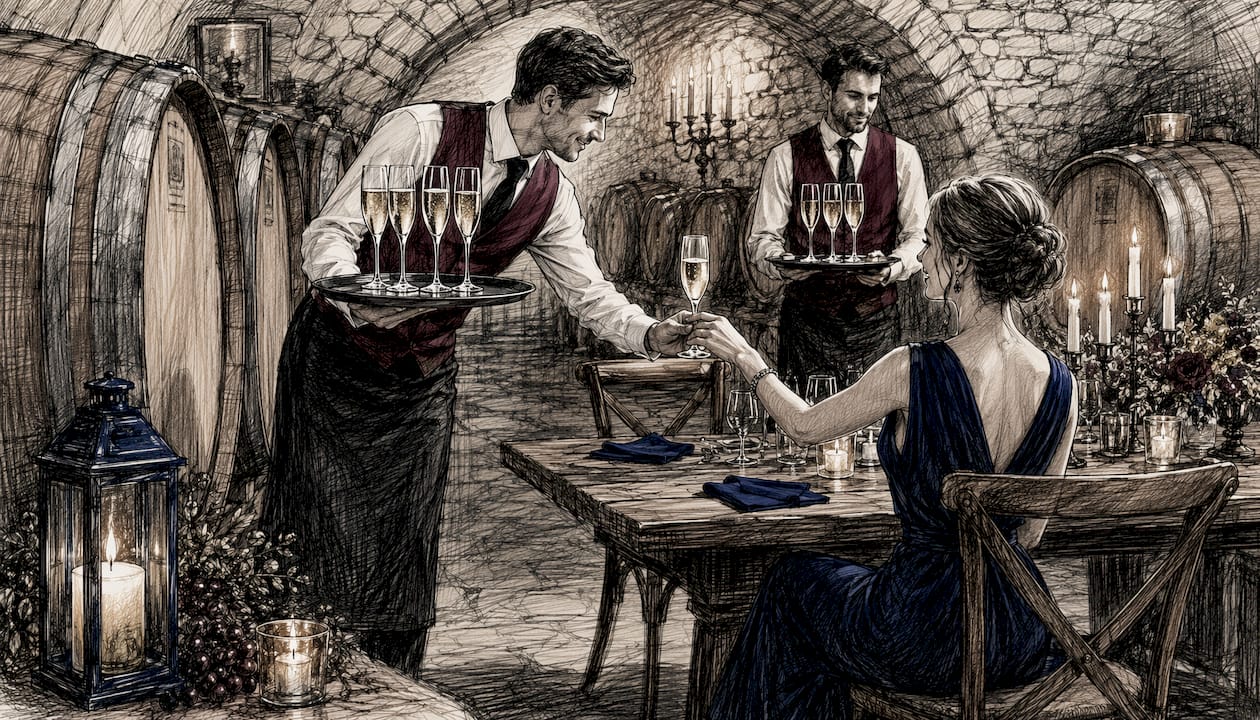
Pro Tip: Brief wait staff to offer a non-alcoholic alternative alongside every champagne pass. Guests who do not drink alcohol should never feel excluded from a celebratory moment.
How do styling and presentation lift a tower to a luxury experience?
Small presentation choices carry outsized weight. The levers that matter most are lighting, glassware quality, florals, and the tower’s position within the room.
Warm uplighting or a single pin spot directed at the tower creates a focal point, photographing beautifully and drawing guests in. Coupe glasses read as more luxurious than flutes in most settings, and their wider rim makes the cascade more dramatic. For champagne towers with flowers, use fire-safe arrangements and keep fresh fruit garnishes food-hygiene compliant by sourcing them from a catering supplier rather than a florist.
Position the tower where it is visible from the main guest area but not blocking a fire exit, a service route, or the photographer’s key angles. Sightlines and safety are not in conflict when the room is mapped properly in advance.
Accessibility matters too. Guests with mobility issues should be able to receive a glass from a staff member without having to approach the tower itself. Brief your pour lead to circulate actively during the service window.
Pro Tip: Ask your photographer to capture the initial cascade pour. That moment, a tower overflowing with champagne, is one of the most shareable images from any luxury event and costs nothing extra to plan for.
Contingency planning for live events: spillage, breakage and last-minute changes
Act immediately and quietly. The guest experience depends on how fast and how discreetly your team responds.
- Spillage: cordon the area within 30 seconds, deploy absorbent cloths from the pre-staged kit, and resume service from a contingency bottle without pausing the event.
- Breakage: clear glass is a safety priority. Stop service at that station, remove guests from the immediate area, and complete a full sweep before reopening. Never rush a glass clear-up.
- Guest number changes: if numbers increase by more than 10% on the day, activate contingency stock immediately. If numbers drop, reduce the active pour stations rather than running a visibly sparse tower.
- Supplier no-show or late arrival: have the supplier’s emergency contact and a venue contact on a single shared message thread before the event starts.
- Communication: keep any incident quiet and resolved before guests notice. A brief, calm word to the venue coordinator is all that is needed.
Pro Tip: Stage all contingency stock, spare glasses, cloths, and extra bottles in a locked service area the venue team can access without entering the guest space. Visible backstage chaos undermines a luxury atmosphere instantly.
What should you ask your champagne-tower supplier?
Your supplier brief must cover guest count, service style, venue licence status, set-up window, and liability and insurance before any contract is signed.
A quote that does not specify staffing ratios, insurance limits, and teardown time is not a complete quote. Ask for all three in writing before you compare prices.
Essential questions to ask:
- What is the tower footprint and what surface is required for safe installation?
- Are staff DBS-checked and trained in responsible alcohol service?
- What public liability insurance do you hold, and can you provide a certificate?
- What is your replacement policy if glasses break during service?
- What is your teardown time, and who is responsible for removing the tower?
- Does your quote include travel, parking, and any overnight accommodation if required?
Contract points to pin down:
- Cancellation and postponement terms, including force majeure.
- Additional-hour pricing if the event overruns.
- Who holds responsibility for the TEN or premises licence.
- Whether the supplier’s insurance covers the venue’s specific requirements.
Pro Tip: Ask to see a photo portfolio or tower examples from comparable events before you book. A supplier who cannot show you their work at a similar scale is a risk.
Cost drivers and a realistic planning timeline
Tower size, staffing hours, bespoke styling, travel distance, and venue access constraints are the five factors that move the price most. Decoration choices such as flowers on the tower and custom glassware add cost but also add perceived value that guests notice.
| Milestone | Recommended timing |
|---|---|
| Reserve supplier and agree provisional date | 3–6 months before event |
| Confirm venue licence or apply for TEN | several weeks before the event |
| Finalise guest numbers and tower size | 4–6 weeks before event |
| Confirm staffing, styling and contingency stock | 2–3 weeks before event |
| Supplier delivery and set-up | Day before or morning of event |
| Teardown and venue sign-off | Within agreed window post-event |
Budget factors to watch: transport costs for large towers, overtime staffing if the event runs long, insurance certificates required by the venue, and a contingency stock allowance of 10–15% above your calculated bottle count.
Key takeaways
Confirming guest numbers and service style is the single most important decision you will make, because every other planning choice, from tower size to staffing to licence type, flows directly from those two facts.
| Point | Details |
|---|---|
| Confirm numbers and service style first | Guest count and service format determine tower size, staffing, and licence requirements. |
| Check TEN or premises licence early | Apply for a TEN well in advance; a TEN covers events under 500 people for up to 168 hours. |
| Build in a 10–15% overage buffer | Running short mid-service at a luxury event damages the guest experience more than leftover stock. |
| Brief your supplier in writing | Require staffing ratios, insurance limits, and teardown time in writing before comparing quotes. |
| Champagnetowerhire for turnkey service | Champagnetowerhire provides fully staffed, bespoke UK champagne and prosecco tower hire with safety and styling included. |
Why specialist suppliers make the real difference
The conventional wisdom is that any competent caterer can manage a champagne tower. Having seen how quickly a poorly briefed team can turn a showpiece moment into a liability, I disagree. The cascade pour is a live, physical event. Glass stability, pour sequence, spill response, and staff positioning all have to be rehearsed, not improvised on the day.
Specialist suppliers bring pre-tested equipment, trained staff who have handled the specific failure modes, and insurance that actually covers the display. Champagnetowerhire’s event beverage display guide reflects exactly this kind of operational depth: it addresses safety, styling, and service flow in a way that a generalist caterer’s briefing notes simply do not. For a luxury event where the tower is a centrepiece, that operational rigour is what separates a memorable moment from an embarrassing one.
Champagnetowerhire: turnkey luxury towers for UK events
Organisers who want a fully staffed, visually spectacular champagne or prosecco display without the operational risk should contact Champagnetowerhire directly. A full-service package typically includes a custom-built tower sized to your guest count, trained staff for the full service window, styling options such as florals and bespoke glassware, public liability insurance confirmation, and complete set-up and teardown. Whether you are planning a wedding, a corporate celebration, or a private party, the team will need your guest count, venue address, event date, and licence status to prepare an accurate quote. Request yours at champagnetowerhire.co.uk.
Useful sources and further reading
UK legal and regulatory references:
- Licensing Act 2003 — primary legislation for alcohol licensing in England and Wales.
- Alcohol licensing guidance — GOV.UK — premises licences, personal licences, and TEN requirements.
- Temporary Event Notice — GOV.UK — TEN application process; covers events under 500 people for up to 168 hours.
- S182 Guidance (February 2026) — revised statutory guidance on regulated entertainment and late-night refreshment.
Practical planning resources:
- NCASS — how to tell if you need an alcohol licence — guidance on free provision and licensable activities.
- Vivid Bar Services — drinks per guest calculations — consumption rate guidance aligned with event format and timing.
- Wild Foodz — festive meal offerings for event planners — catering ideas to complement a champagne tower display.
Champagnetowerhire resources:
- Event beverage display guide — service planning and safety guidance for organisers.
- Drink display safety guide — essential safety controls for display builds.
- Tower examples for events — visual portfolio and case studies.
A TEN covers events with fewer than 500 people and a maximum duration of 168 hours — the standard authorisation for one-off private events at unlicensed venues in England and Wales.


