

TL;DR:
- Effective beverage displays must be accurately specified using terminology that clarifies unit types, placement, and safety standards. Proper knowledge of display categories, planogram compliance, and product descriptors ensures optimal presentation and compliance with retail standards. Using precise language when briefing suppliers helps avoid misunderstandings and creates displays that enhance guest perception and safety.
Industry terminology for drink displays refers to the specialised vocabulary used to describe beverage merchandising units, display structures, and presentation practices in both event and retail settings. For event planners, this language is not optional background knowledge. It is the foundation for accurate supplier briefs, confident venue conversations, and displays that look as good in reality as they do on a mood board. This guide covers the core categories of beverage display terms, from display unit types and planogram compliance through to product descriptors and structural safety, so you can specify exactly what you need and get it right first time.
What are the main types of beverage display units?
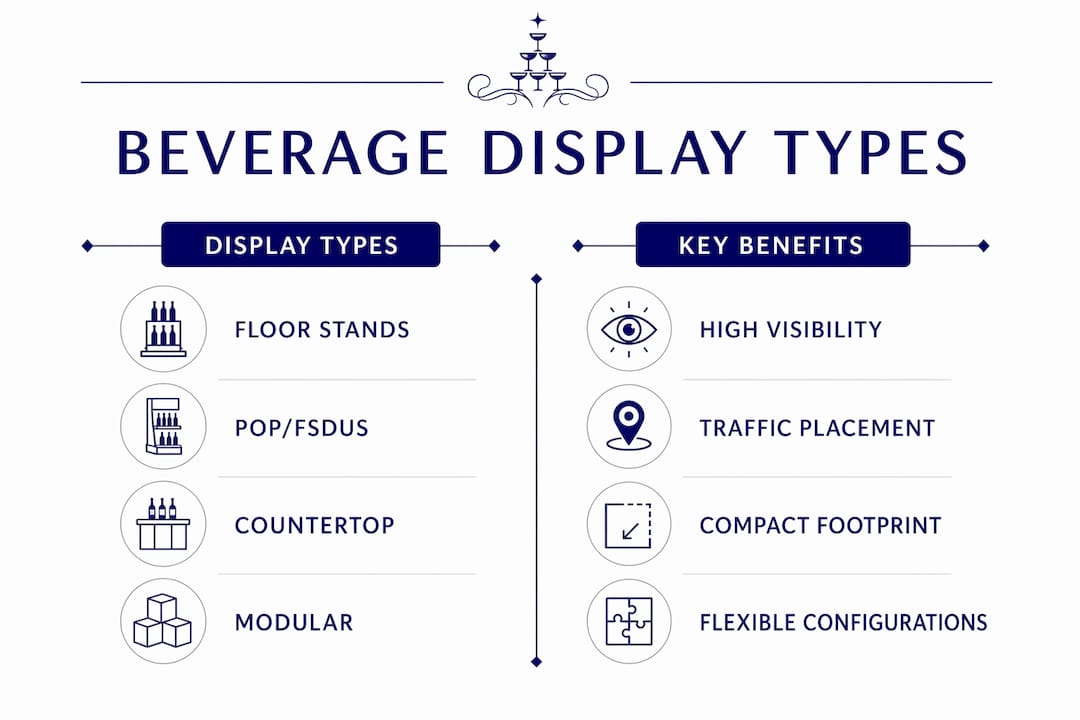
Beverage displays classify into four primary categories, each with a distinct function and placement logic. Understanding these categories is the first step to specifying the right unit for your event.
Floor stands are freestanding structures positioned in open floor space. They provide high visibility across a room and suit events where guests circulate freely, such as receptions or product launches. Their height makes them effective focal points without requiring a table or counter.
POP/FSDUs (point-of-purchase free-standing display units) are designed for high-traffic intersections. In retail, they drive impulse purchases at aisle ends. At events, the same principle applies: place them at natural gathering points, such as entrances or near a bar, to draw attention and encourage interaction. POP and FSDU displays are typically made from corrugated cardboard, which keeps them lightweight and cost-effective for single-use campaigns.
Countertop display stands sit at eye level on a bar or table surface. They maximise product visibility in a compact footprint and work well for featured bottles, premium spirits, or branded glassware. Acrylic and metal versions offer a more permanent, upscale finish suited to luxury events.
Modular displays are the most flexible category. They consist of interchangeable components that can be reconfigured between events or campaigns. Modular display systems offer reusability and campaign flexibility, making them a sound investment for planners who run multiple events across a season.
| Display type | Typical material | Best placement | Key benefit |
|---|---|---|---|
| Floor stand | Metal, acrylic | Open floor space | High visibility, strong focal point |
| POP/FSDU | Corrugated cardboard | Entrances, aisle ends | Impulse engagement, low cost |
| Countertop stand | Acrylic, metal | Bar tops, tables | Eye-level presence, compact |
| Modular display | Mixed materials | Flexible locations | Reusable, reconfigurable |
Pro Tip: When briefing a supplier, always specify the display type by its category name rather than a description. “A countertop acrylic stand for three featured bottles” is far clearer than “something small for the bar,” and it eliminates back-and-forth that delays delivery.
How does planogram compliance impact beverage display effectiveness?
Planogram compliance is the degree to which a physical display matches an approved visual blueprint, known as a planogram. The planogram specifies shelf height, product facings, pricing communication, and signage placement. High planogram compliance is the chief metric retailers use to determine whether a supplier’s display earns long-term shelf placement.
The performance impact is measurable. Planogram compliance correlates to a 5–10% category performance lift in retail beverage alcohol sales. That figure matters to event planners because many corporate and hospitality events operate within retail partner guidelines, meaning your display must meet the same compliance standards as an in-store setup.
For event-specific setups, planogram thinking translates directly into display discipline. Consider these compliance principles:
- Shelf height: Position featured products at eye level (roughly 1.2–1.5 metres from the floor) to maximise guest engagement.
- Facing counts: The number of product units visible from the front. More facings signal prominence and availability. A premium spirit should have at least two to three facings on a countertop stand.
- Pricing communication: Clear, consistent price or product information at the point of display. At events, this might be a branded card or a menu insert rather than a shelf edge label.
- Signage placement: Brand signage should sit above the product line, not obscure it. Blocking the label defeats the purpose of the display.
Planogram compliance also protects you during post-event reviews with retail or brand partners. A display that matches the agreed blueprint demonstrates professionalism and builds trust for future bookings.
What product and service terminology should event planners know?
Event planners regularly encounter beverage product terminology that originates in the drinks trade. Misunderstanding these terms leads to wrong product orders, awkward supplier conversations, and menus that do not reflect what is actually being served.
The most common product descriptors to know are:
- ABV (Alcohol By Volume): The percentage of alcohol in a drink. Spirits typically range from 35–45% ABV. This figure determines licensing requirements and informs portion planning.
- Proof: An older measure equal to double the ABV. A spirit at 40% ABV is 80 proof. Some premium spirit brands still use proof on their labelling.
- VS, VSOP, XO: Cognac and brandy aging designations. VS (Very Special) indicates a minimum of two years’ ageing, VSOP (Very Superior Old Pale) a minimum of four years, and XO (Extra Old) a minimum of ten years. These designations affect both price point and display positioning.
- Neat: A spirit served at room temperature with no ice, water, or mixer.
- On the rocks: A spirit served over ice.
- Straight up: A spirit chilled by shaking or stirring with ice, then strained into a glass with no ice.
Beverage merchandising is distinct from beverage marketing, and planners benefit from understanding the difference. Marketing builds brand awareness through advertising and campaigns. Merchandising focuses on in-store or in-event placement and display tactics to drive decisions at the point of sale. When a brand representative talks about “POS,” they mean point-of-sale materials: shelf talkers, bottle neckers, branded ice buckets, and display cards. These are merchandising tools, not marketing assets.
Pro Tip: Ask your drinks supplier for their POS kit when confirming an order. Most premium spirit and champagne brands supply branded display materials at no extra cost. Using them correctly signals to guests that the display is curated, not assembled.
What structural factors should event planners consider for drink displays?
The physical demands of a fully stocked beverage display are frequently underestimated. Heavy beverage displays can exceed 20–30kg when fully stocked, particularly units holding four or more shelves of bottles. That weight requires a display engineered to carry the load safely, not just to look good in a showroom.
Structural considerations for event planners should follow this sequence:
- Confirm the load capacity before ordering. Ask the supplier for the maximum weight rating per shelf and for the unit overall. A display rated for 10kg per shelf will fail if you load it with six 1.5kg bottles per shelf.
- Check for structural fatigue in modular systems. Modular displays are prone to failure if they were designed primarily for showroom use rather than repeated loading and unloading. Ask whether the unit has been tested for repeated assembly cycles.
- Assess restock speed. At a busy event, staff need to restock a display quickly without dismantling it. Displays with open shelving and wide access points are faster to restock than enclosed units with doors or complex locking mechanisms.
- Match the material to the environment. Cardboard FSDUs are unsuitable for outdoor events or humid marquee settings. Metal and acrylic units handle temperature variation and moisture far better.
- Plan for safe dismantling. A display loaded with glass bottles at the end of a long event is a safety risk if the structure has weakened. Build a dismantling protocol into your event run sheet.
Beverage displays function best when they balance visual appeal with practical load-bearing capability. A display that looks spectacular but collapses mid-event is a liability, not an asset. Specify structural requirements in writing when placing your order.
Planners working on luxury beverage displays for high-end events should also consider the visual weight of a display. A tall, fully stocked floor stand can dominate a room in a way that feels imposing rather than elegant. Proportion matters as much as capacity.
Key takeaways
Mastering drink display terminology gives event planners the precise language to specify, brief, and manage beverage setups that are both visually impressive and structurally sound.
| Point | Details |
|---|---|
| Four core display types | Floor stands, POP/FSDUs, countertop stands, and modular displays each serve distinct placement and function needs. |
| Planogram compliance drives performance | Matching a visual blueprint for shelf height, facings, and signage can lift category performance by 5–10%. |
| Product terms affect ordering accuracy | ABV, Proof, and aging designations (VS, VSOP, XO) determine correct product selection and display positioning. |
| Structural load is a safety issue | Fully stocked displays can exceed 20–30kg; always confirm weight ratings before installation. |
| Merchandising differs from marketing | Merchandising targets point-of-sale decisions through placement and display; marketing builds broader brand awareness. |
Why terminology is the most underrated skill in event planning
I have watched planners spend weeks perfecting a colour palette and then lose an entire day to a supplier misunderstanding because nobody used the right words. The supplier sent a countertop stand when the brief called for a floor-standing FSDU. The bottles arrived with no POS kit. The display looked bare and unbranded on the night.
The drinks trade has a precise vocabulary for good reason. When you say “three-shelf modular floor stand with open-face shelving, rated to 15kg per shelf,” a supplier knows exactly what to build. When you say “something tall for the bottles,” you are leaving the interpretation to someone who has never seen your venue.
I also think planners underestimate how much product terminology shapes guest perception. A display labelled with the correct aging designation for an XO cognac tells guests something about the quality of the event. It signals that the planner understood what they were serving, not just what it looked like. That detail is invisible when it is right and glaring when it is wrong.
The terminology covered here is not exhaustive. Drink merchandising is a deep field, and retail compliance standards evolve. But the categories and terms in this guide cover the vast majority of what you will encounter when briefing suppliers, reviewing proposals, or setting up a display on the day. Get these right, and the rest follows.
— Darren
How Champagnetowerhire brings display expertise to your event
Champagnetowerhire specialises in bespoke champagne and prosecco tower displays for weddings, corporate functions, and private parties across the UK and internationally. Every setup is fully staffed and built to specification, so you receive a display that is both structurally sound and visually spectacular. The team handles everything from tower configuration and glassware to optional additions such as fresh flowers and strawberries. For planners who want a wedding champagne tower that doubles as a centrepiece, Champagnetowerhire offers a free instant online quote to get your planning started without delay. For party and corporate enquiries, the champagne tower hire for parties page covers available configurations and service options in full.
FAQ
What does FSDU stand for in beverage display terminology?
FSDU stands for free-standing display unit. It is a self-supporting structure placed at high-traffic points to drive product visibility and guest engagement at events or retail locations.
What is planogram compliance in the context of event beverage displays?
Planogram compliance measures how accurately a physical display matches an approved visual blueprint. It covers shelf height, product facings, signage, and pricing communication, and it correlates to a 5–10% performance lift in beverage alcohol categories.
What is the difference between ABV and Proof?
ABV (Alcohol By Volume) is the percentage of alcohol in a drink. Proof is double the ABV figure. A spirit at 40% ABV is therefore 80 proof.
What does POS mean in drink merchandising terminology?
POS stands for point of sale. In drink merchandising, POS refers to branded display materials such as shelf talkers, bottle neckers, and display cards placed at the point where a guest or shopper makes a purchasing decision.
What is the difference between beverage merchandising and beverage marketing?
Beverage marketing builds brand awareness through advertising and campaigns. Beverage merchandising focuses on in-event or in-store placement and display tactics designed to influence decisions at the point of sale.


