

TL;DR:
- Effective event logistics involves detailed planning from start to finish to ensure smooth execution. Starting early and working backward from the event date helps coordinate dependencies, staff, and supplier timelines efficiently. Proper on-site roles and fixed deadlines prevent delays and make the event memorable.
Event logistics is defined as the comprehensive process of planning, coordinating, and executing every operational element required to deliver a successful event. It covers everything from vendor procurement and staffing plans to on-site load-in management and post-event breakdown. Poor logistics is the single most common reason events fail to meet expectations, regardless of budget or venue quality. Whether you are planning an intimate wedding reception or a multi-city corporate conference, understanding event logistics gives you the operational foundation to deliver an experience your guests will remember for all the right reasons. Champagnetowerhire works alongside this framework every day, bringing timeline-conscious luxury displays to events across the UK.
What are the key stages of event logistics?
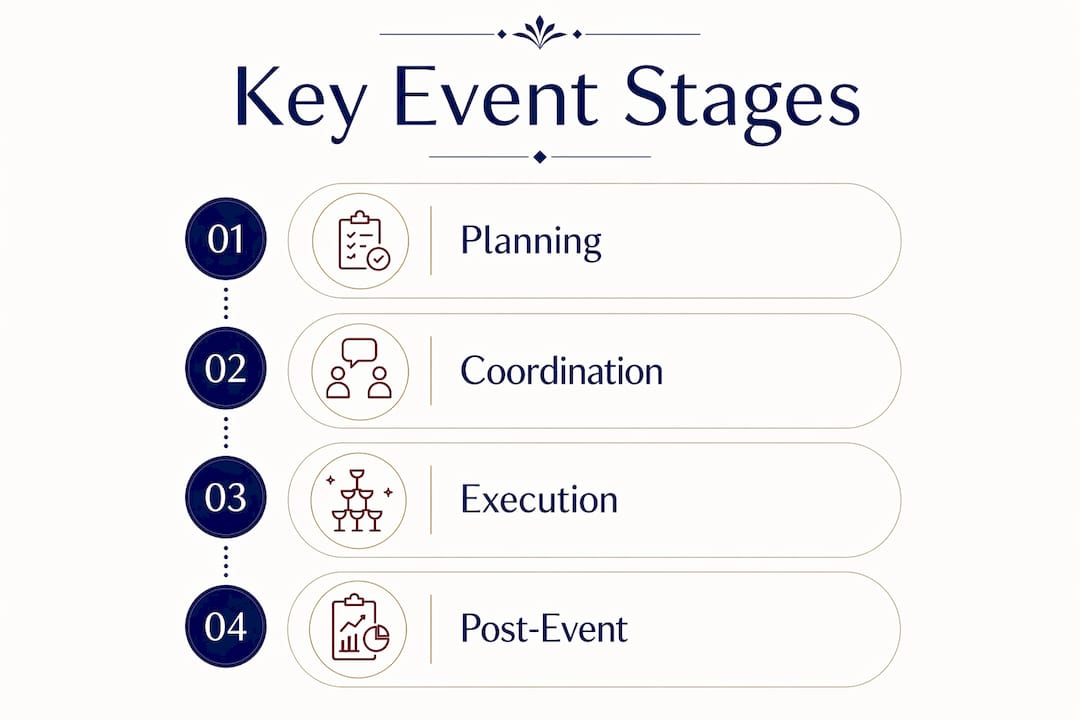
Event logistics divides into three distinct phases: pre-event, on-site, and post-event. Each phase carries its own priorities, documents, and risks. Treating them as separate disciplines rather than one continuous task is the mark of a professional planner.
Pre-event logistics is where the majority of your work happens. This phase covers:
- Procurement of equipment, furniture, and specialist hire items
- Staffing plans and briefing documents for every role
- Vendor coordination using a vendor matrix (a single document listing every supplier, their contact, delivery window, and dependencies)
- Timeline establishment, including a run-of-show document that maps every minute of the event day
- Venue access agreements, including dock booking slots and load-in permissions
On-site logistics is where plans meet reality. The core tasks include:
- Managing load-in and load-out sequences to avoid clashes
- Coordinating staff across multiple zones in real time
- Solving problems as they arise without disrupting the guest experience
- Maintaining operational flow through clear communication channels
Post-event logistics is the phase most planners underestimate. It includes:
- Structured breakdown and equipment collection
- Returning hired items within agreed windows to avoid penalty charges
- Finalising vendor payments and collecting invoices
- Writing a post-event report to capture lessons for future planning
The run-of-show and vendor matrix are the two documents that hold all three phases together. Without them, information lives in email threads and memory, and both are unreliable on event day.
How to plan your event logistics timeline and checklist
The planning window is the single most important variable in event logistics management. For events with 200 or more attendees, planners should begin logistics operations at least 10–12 weeks before the event date. Larger, multi-city events require six months or more. Starting late compresses every subsequent decision and removes your ability to recover from supplier failures.
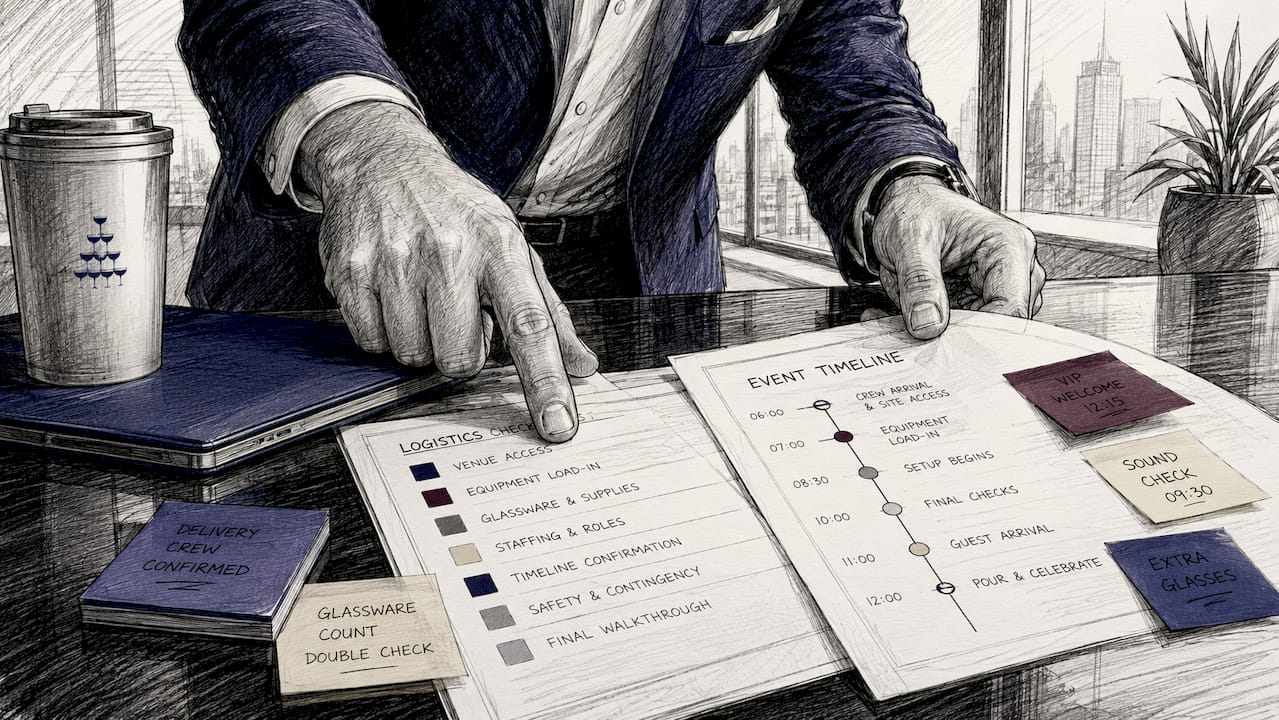
The most effective method is backward logistics planning. Working back from the ‘doors open’ moment ensures every dependency, from signage approval to rigging clearance, is completed before guests arrive. Start with the event start time, then map each task in reverse order to identify its latest possible completion date.
A structured checklist is your primary tool for executing this plan. Planners who use a timeline-driven checklist reduce last-minute stress by an average of 65% and report significantly higher satisfaction with their event outcomes. That figure reflects a real operational difference, not just peace of mind.
A practical event logistics checklist should follow this sequence:
- Confirm the event brief and guest count so every subsequent decision is sized correctly
- Book the venue and negotiate access windows including load-in and load-out times
- Build your vendor matrix with every supplier, their contact details, and their delivery slot
- Draft the run-of-show and share it with all key stakeholders for sign-off
- Assign a timeline manager who owns the schedule and chases dependencies daily
- Conduct a site visit to identify dock access, lift dimensions, and power points
- Freeze all design decisions at least two weeks before the event date
- Run a full briefing with all on-site staff 48 hours before the event
- Confirm all vendor arrival times in writing no later than one week out
- Build a 20-minute buffer into every major transition on the run-of-show
Design changes after the two-week freeze point increase costs and create operational stress across multiple suppliers simultaneously. Treat the freeze date as non-negotiable.
Pro Tip: Assign a single timeline manager whose only job on event day is to watch the clock and flag any task running more than five minutes behind schedule. This role prevents the common failure mode where everyone assumes someone else is tracking time.
For champagne tower timeline planning and other specialist hire items, build the setup window into your run-of-show at least 90 minutes before guests arrive. Specialist displays require precise positioning, structural checks, and a final pour test before the room opens.
What practical challenges arise on event day and how do you manage them?
Event day logistics operate under a condition most planners underestimate: there is zero tolerance for installation delays. Once the event begins, there is no opportunity to postpone a setup task. Success depends entirely on real-time visibility and instant communication between every stakeholder on site.
The most common source of delay is venue access. An 8-hour get-in window may contain only four hours of actual assembly time, with the remainder consumed by marshalled vehicle movements and rehearsals. Losing a single dock slot can collapse the entire schedule. Book dock slots in writing, confirm them 48 hours before the event, and treat them as fixed appointments.
Pro Tip: Ask your venue for a scaled floor plan of the loading dock and service corridors before you finalise your equipment list. Many planners discover on event day that a key piece of furniture cannot fit through the service lift.
Manual equipment handling, known in the industry as hand-balling, creates two serious risks. Hand-balling extends build time and increases equipment damage. Negotiate venue permissions for trolleys and pump trucks weeks in advance, not on the morning of the event.
The following on-site roles are non-negotiable for events above 150 guests:
- Marshalling lead: stationed at the venue entrance with a high-vis vest and dock booking sheet. A dedicated marshalling lead prevents blocked access and eliminates the inefficiency of drivers self-marshalling their own vehicles.
- Floor manager: coordinates all on-site staff and acts as the single point of contact for the event director
- Supplier liaison: meets every incoming vendor at the dock and escorts them to their designated zone
For guest experience to feel effortless, the operational machinery behind it must be invisible. That invisibility is the direct result of thorough on-site logistics planning.
For multi-day or multi-venue events, a specialist logistics partner adds genuine value. Their true contribution lies in venue dock relationships and their ability to manage the chaotic, exhausted post-event breakdown phase with calm professionalism.
How does event logistics differ across event types?
Core logistics principles apply universally, but the priorities shift significantly depending on the event format. The table below outlines the key differences.
| Event type | Primary logistics focus | Key risk | Planning window |
|---|---|---|---|
| Wedding | Beverage displays, timing, and supplier sequencing | Ceremony overrun affecting catering | 10–12 weeks minimum |
| Corporate conference | Registration flow, AV staging, and security | Speaker schedule delays | 12–16 weeks |
| Private party | Venue access, décor setup, and staffing ratios | Overcrowding and service gaps | 6–8 weeks |
| Multi-venue conference | Cross-site coordination and transport logistics | Communication breakdown between sites | 6+ months |
Weddings demand precise timing coordination above all else. The ceremony, drinks reception, and dinner service are sequential and interdependent. A 20-minute overrun in the ceremony compresses the drinks reception, which in turn delays the kitchen. Specialist hire items such as luxury beverage displays must be built and signed off before guests move from the ceremony space to the reception area.
Corporate events require a different emphasis. Registration queues are the first impression guests receive, and a slow check-in process sets a negative tone before the programme begins. Security workflows, badge printing, and AV checks all need dedicated leads and their own mini run-of-show documents. The corporate event champagne workflow follows the same principle: every display element must be ready before the first guest enters the room.
Multi-venue events are the most logistically demanding format. Communication between sites is the primary failure point. Dedicated site managers at each venue, a shared digital communication channel, and a central logistics coordinator who floats between sites are the minimum requirements. For festive meal planning across multiple venues, a unified catering brief and shared timeline document prevent the menu inconsistencies that damage brand reputation.
Key takeaways
Effective event logistics requires backward planning from the event start time, a frozen design deadline two weeks out, and dedicated on-site roles for every event above 150 guests.
| Point | Details |
|---|---|
| Start planning early | Begin logistics operations 10–12 weeks out for 200+ attendees; six months for multi-venue events. |
| Plan in reverse | Work backward from ‘doors open’ to confirm every dependency is secured before guests arrive. |
| Use a structured checklist | A timeline-driven checklist reduces last-minute stress by an average of 65%. |
| Appoint a marshalling lead | A dedicated marshalling lead at the dock prevents access delays and load-in inefficiencies. |
| Freeze design decisions early | Lock all design changes at least two weeks before the event to avoid cost increases and supplier stress. |
Why I think most planners underestimate the load-in window
The part of event logistics that catches even experienced planners off guard is not the planning phase. It is the gap between the access time written in the venue contract and the actual working time available on event day.
I have seen planners arrive at a venue with an 8-hour get-in window and discover they have four usable hours once marshalled vehicle movements, rehearsals, and safety checks are accounted for. That is not a venue failing to communicate clearly. It is a planner failing to ask the right questions during the site visit.
The fix is straightforward but requires discipline. Ask the venue operations manager to walk you through a typical load-in day, not just hand you a schedule. Ask which dock slots are shared with other events. Ask whether the service lift has a booking system. These conversations reveal the real working window before you commit your run-of-show to it.
The second thing I would push back on is the assumption that a logistics partner is a luxury for large events only. For any event with more than three specialist suppliers arriving in the same window, a logistics partner pays for itself in avoided delays and equipment damage alone. Their venue relationships and their composure during breakdown are worth more than any spreadsheet you can build.
Good logistics does not make an event memorable. It makes an event possible. The memorable part is what you build on top of it.
— Darren
How Champagnetowerhire fits into your event logistics plan
Champagnetowerhire specialises in luxury champagne and prosecco tower hire for weddings, private parties, and corporate events across the UK. Every setup is fully staffed, built to a confirmed timeline, and coordinated directly with your venue’s operations team. That means one less supplier for you to chase on event day and one more element of your run-of-show that arrives on time and looks extraordinary.
For weddings, the champagne tower hire service includes bespoke tower sizes, optional flowers and strawberries, and a final pour test before guests enter the room. For parties and corporate functions, the champagne tower for parties service delivers the same turnkey experience. Use the instant quote tool on the Champagnetowerhire website to get a price in minutes and lock in your date.
FAQ
What is event logistics in simple terms?
Event logistics is the process of planning, coordinating, and executing every operational element of an event, from vendor management and staffing to on-site setup and post-event breakdown.
How far in advance should I start planning event logistics?
For events with 200 or more attendees, begin at least 10–12 weeks before the event date. Multi-city or multi-venue events require six months or more of lead time.
What is a run-of-show document?
A run-of-show is a minute-by-minute schedule of every event day task, assigned to a named person, used to keep all suppliers and staff aligned throughout the event.
Why is a marshalling lead important on event day?
A dedicated marshalling lead stationed at the venue entrance prevents blocked dock access and eliminates the delays caused by delivery drivers self-directing their own vehicles.
What is the design freeze deadline in event planning?
The design freeze is the point, typically two weeks before the event, after which no further changes are made to layouts, branding, or equipment lists, as late changes increase costs and create supplier confusion.


