

TL;DR:
- Most luxury UK weddings feature champagne towers as focal points for visual impact.
- Building stable, precise towers with coupe glasses and careful pouring ensures safety and elegance.
- Eco-friendly, personalized, and floral embellishments are trending in upscale champagne display styling.
At luxury UK weddings and upscale private parties, the pressure to create a showstopping centrepiece has never been greater. Over 80% of luxury UK weddings now feature champagne towers or standout beverage displays as their visual focal point, and it’s easy to see why. A beautifully constructed champagne tower commands attention the moment guests walk through the door. This guide gives you a practical, step-by-step walkthrough covering everything from essential ingredients and glass selection through to construction, styling, safety, and the finishing touches that transform a good display into an extraordinary one.
Table of Contents
- Essential ingredients and requirements
- Step-by-step construction for an elegant display
- Styling, embellishment, and eco-conscious considerations
- Verification, safety, and operational tips
- The truth luxury event planners overlook about elegant drink displays
- Elevate your event with a luxury drink display
- Frequently asked questions
Key Takeaways
| Point | Details |
|---|---|
| Plan each detail | Having the right glassware, quantities, and chilled champagne is crucial for a flawless display. |
| Follow precise steps | Building the tower in ordered tiers and pouring carefully ensures both safety and spectacle. |
| Style for impact | Edible gold, flowers, and sustainable accents add modern elegance and wow your guests. |
| Prioritise safety always | A level base, risk checks, and professional staff prevent mishaps and keep luxury events stress-free. |
| Sustainability matters | Eco-conscious materials and local beverages are quickly becoming the hallmark of 2026 UK events. |
Essential ingredients and requirements
With the scene set, it’s vital to gather and prepare every element for a seamless champagne tower. Getting this foundation right is what separates a polished, professional display from a last-minute scramble.
Glass type matters more than most planners realise. Coupe glasses (the wide, shallow saucers) are the gold standard for towers because their broad base creates a stable, interlocking structure. Flutes are elegant, but their narrow base makes stacking precarious. If you want to understand the full reasoning behind choosing the right glass, it comes down to surface contact and weight distribution. For large-scale displays, coupes every time.
Here’s a quick reference for glass and bottle quantities based on event size:
| Tower size | Number of tiers | Glasses needed | Bottles needed |
|---|---|---|---|
| Small | 3 tiers | 14 glasses | 3 bottles |
| Medium | 4 tiers | 30 glasses | 5 to 6 bottles |
| Large | 5 tiers | 55 glasses | 10 bottles |
| Grand | 6 tiers | 91 glasses | 15 to 16 bottles |
For a detailed breakdown of glass counts for towers at various event scales, it’s worth planning well in advance. Running short mid-pour is not an option.
Temperature and champagne selection are equally important. Serve champagne chilled to around 8 to 10 degrees Celsius. A Blanc de Blancs or classic Brut works beautifully for cascading displays, as the fine bubbles create a more visually striking pour. Prosecco is a popular and cost-effective alternative for larger towers.
Key embellishments to gather in advance include:
- Edible gold leaf or gold-dusted strawberries for a lavish finish
- Fresh or silk flowers to frame the base
- Themed ribbons, monogram tags, or branded accessories
- Non-slip matting or a levelled table surface
- A long-handled ladle or pouring spoon for controlled flow
Pro Tip: Always source a few extra glasses beyond your calculated count. Breakages happen, and having spares on hand means your display stays flawless regardless.
As outlined in the bespoke champagne tower methodology, precise preparation across glass type, count, and styling is what separates a truly elegant display from a chaotic one.
Step-by-step construction for an elegant display
Armed with your ingredients and equipment, you can now turn your vision into a breathtaking centrepiece. Construction is where precision truly counts.
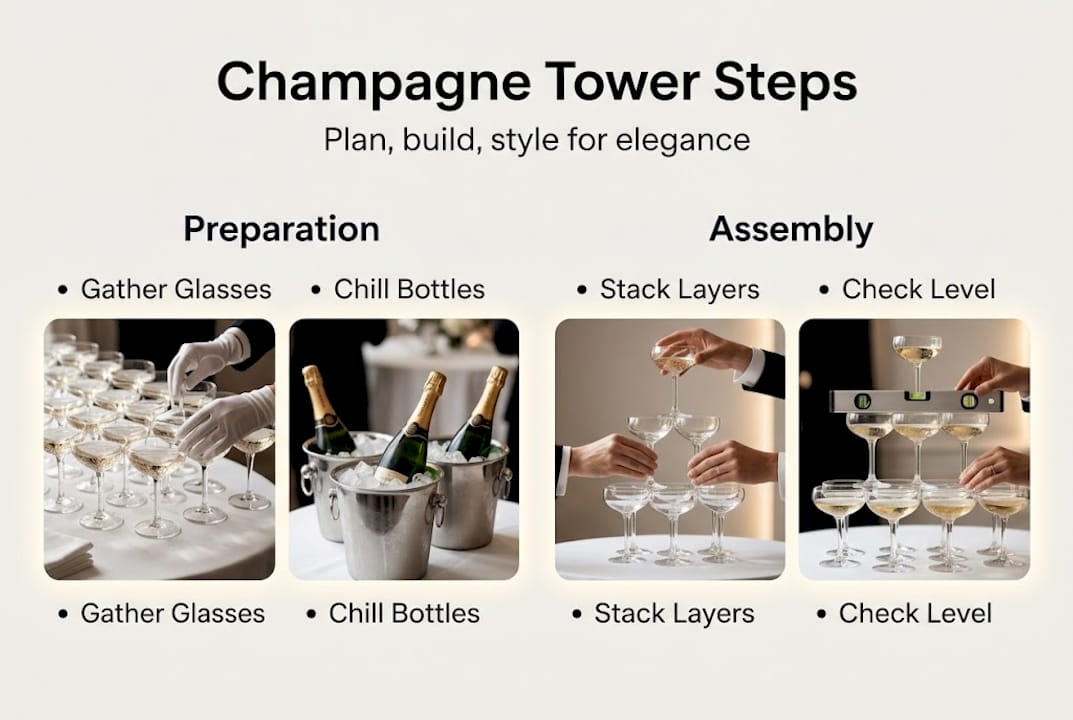
- Choose and level your surface. Use a spirit level to confirm the table or platform is perfectly flat. Even a slight tilt will cause glasses to shift and the pour to flow unevenly. Place non-slip matting beneath the base layer.
- Build your square base layer. Arrange the bottom tier in a tight square or rectangle formation, ensuring each glass touches its neighbour. The champagne display step-by-step approach recommends starting from the outermost corners and working inward.
- Stack subsequent tiers precisely. Each glass in the tier above should sit in the gap between four glasses below, centred and stable. Never rush this stage. Work slowly and check alignment after each row.
- Test stability before any liquid is added. Gently press the top glass with two fingers. If the structure sways, adjust the lower tiers before proceeding.
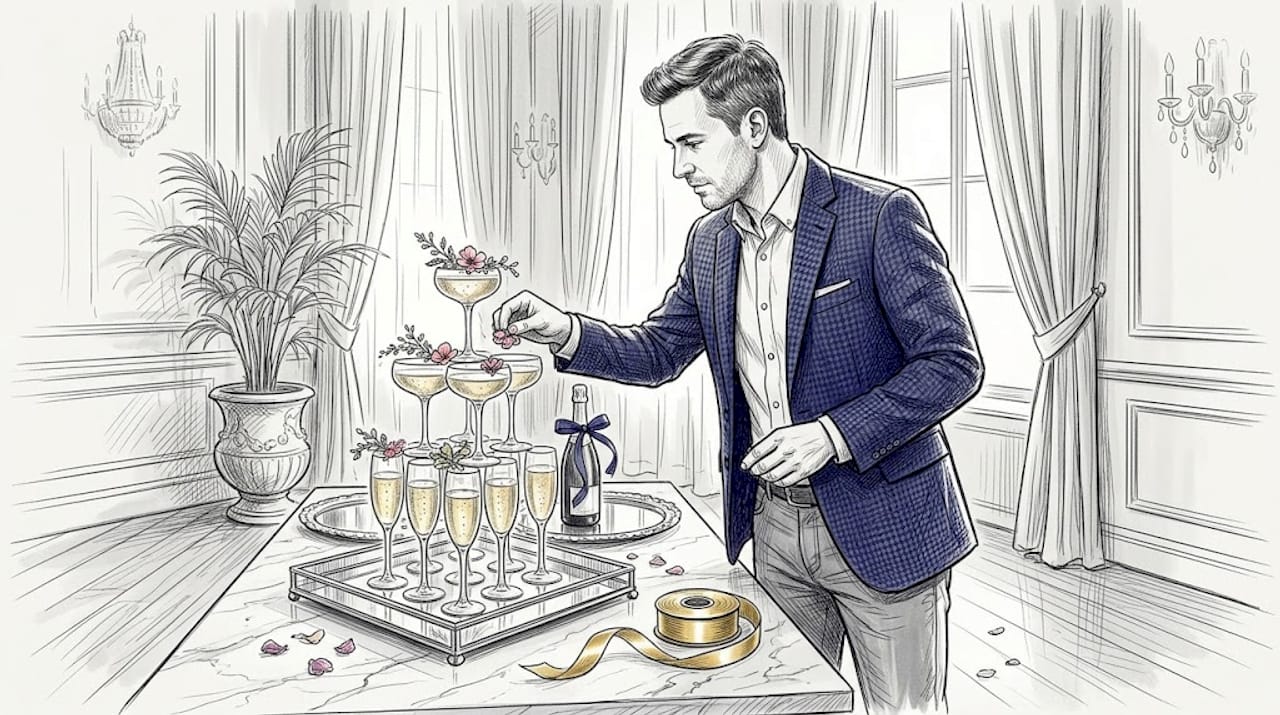
- Position your props and embellishments. Add flowers, gold accents, or decorative elements around the base now, before the pour makes adjustments impossible.
- Execute the pour. Pour slowly into the top glass at a 45-degree angle, using a ladle or spoon to guide the flow. The champagne will cascade naturally downward as each glass fills and overflows.
Here’s a quick comparison of tower shapes and their impact:
| Shape | Stability | Visual drama | Best suited for |
|---|---|---|---|
| Square pyramid | Excellent | High | Weddings, galas |
| Round pyramid | Good | Very high | Intimate parties |
| Rectangular | Very good | Moderate | Corporate events |
Pro Tip: Practise the pour with water during your setup rehearsal. It lets you spot any levelling issues without wasting champagne or creating a sticky mess.
The key principle, as confirmed in the champagne display styling guide, is to build from a square base, nest glasses precisely, and pour slowly from the top. Rushing any of these three steps is where most displays go wrong. You can also explore how to set up a champagne tower for additional configuration options.
Styling, embellishment, and eco-conscious considerations
With your tower erected, the finishing touches will set your display apart and reflect your unique style. In 2026, the most memorable displays combine visual drama with thoughtful, modern choices.
Decorative trends currently leading the UK luxury event scene include:
- Gold leaf pressed onto glass rims for a glamorous shimmer effect
- Edible flowers (such as violets or rose petals) floating in the champagne
- Cascading greenery or seasonal blooms arranged around the tower base
- Personalised monogram picks or wax-sealed tags on the top glass
- Colour-coordinated ribbon tied at the base tier to match event branding
For inspiration on pairing florals with your display, the guide to towers with flowers offers stunning examples across different event styles.
Eco-conscious choices are no longer a niche preference. Sustainable glassware and local sparkling wines are rising rapidly across luxury UK events, with couples and corporate hosts alike seeking displays that reflect their values. Hiring reusable crystal coupes rather than purchasing disposable alternatives reduces waste significantly. Sourcing English sparkling wine, such as those from Sussex or Kent vineyards, adds a regional story to your display that guests genuinely appreciate.
Eco-elegance in 2026: Swapping imported champagne for award-winning English sparkling wine can reduce your event’s carbon footprint while adding a compelling, locally rooted narrative to your celebration.
Visual integration matters enormously. Your tower should feel like a natural extension of your event’s overall aesthetic, not an afterthought. Coordinate the colour of your flowers and accessories with your table linens, stationery, and floral arrangements. For broader drinks presentation ideas that tie your entire beverage display together cohesively, it’s worth reviewing your full event palette before finalising embellishments.
Verification, safety, and operational tips
Completing your luxury drink display means not just aesthetics, but ensuring safety, functionality, and event success. This stage is where many planners underestimate the detail required.
“A champagne tower is a structural installation as much as a decorative one. Treat it accordingly, and your guests will enjoy a flawless, memorable moment. Overlook it, and even the most beautiful display can become a liability.”
Here’s a structured verification checklist to follow before guests arrive:
- Conduct a full structural test. Press lightly on the top tier and observe for any movement. Adjust any glasses that rock or sit unevenly.
- Confirm surface stability. Recheck the table or platform with a spirit level. Vibrations from music or footfall can shift surfaces during an event.
- Complete a Health and Safety risk assessment. For large-scale towers at UK events, a formal risk assessment is not optional. It is a legal requirement under UK health and safety law, particularly when the public or a large number of guests are present.
- Brief your team. Ensure every member of staff knows their role during the pour. One person pours, one monitors the structure, and one manages guest positioning.
- Prepare for spills. Place absorbent matting beneath the table and have clean cloths on standby. A small spill is manageable; an unprepared team makes it a spectacle.
For large towers, professional oversight is strongly advised. Expert staff who regularly create showstopping champagne displays understand structural nuances that even experienced planners can miss. The guidance is clear: use coupes for stability, test the structure before pouring, and never skip the risk assessment.
The truth luxury event planners overlook about elegant drink displays
Here’s something the glossy event magazines rarely say plainly: a visually stunning champagne tower that tips, spills, or creates a safety incident does not become a cherished memory. It becomes the story guests retell for the wrong reasons.
The real shift we’re seeing in 2026 is that the most celebrated displays are not simply the tallest or the most ornate. They are the ones where guests feel genuinely included in the moment, where the pour is theatrical but controlled, and where the values of the host are reflected in thoughtful, sustainable choices. The importance of beverage displays at luxury events goes far beyond aesthetics.
Planners who rethink the classic ritual, prioritising interactive elements, eco-conscious sourcing, and professional execution over sheer visual scale, consistently achieve more lasting impressions. Lavishness alone is not the statement it once was. Intention is.
Elevate your event with a luxury drink display
If you’re ready to bring your vision to life, working with a specialist team makes all the difference. At Champagne Tower Hire, we handle every detail from structural setup and glass selection through to staffing and styling, so you can focus entirely on your guests. Whether you’re planning an intimate wedding or a grand gala, our bespoke service is designed around your brief.
Browse our wedding beverage display checklist for inspiration, or explore our display styling tips to see how we tailor every tower to its setting. Get in touch today and let’s create something truly unforgettable together.
Frequently asked questions
What type of glass is best for an elegant champagne tower?
Crystal coupes are the preferred choice for stability and structure, as their wide base allows glasses to interlock securely. For large displays, coupes over flutes are always recommended by professionals.
How many glasses and bottles are needed for a 5-tier tower?
A 5-tier champagne tower typically requires around 55 glasses and 10 bottles of champagne. For a 4-tier tower, 30 glasses and 5 to 6 bottles are the standard quantities.
What are the latest trends in drink display styling for UK events in 2026?
Edible gold, floral accents, and personalised accessories are leading the way, alongside a strong move towards eco-friendly choices. Sustainable glassware and local wines are increasingly popular at luxury UK events.
Is a risk assessment required for a champagne tower display?
Yes, UK health and safety law requires a formal risk assessment before erecting a large tower at a public or private event. A UK Health and Safety assessment protects both guests and the event organiser.
How do you pour champagne to create the cascading effect?
Pour slowly into the top glass at a 45-degree angle, using a long-handled spoon to guide the flow evenly. This controlled pour technique ensures a smooth, dramatic cascade without splashing or overflow.
Recommended
- How to Plan Luxury Drink Displays for Elegant Events
- Elegant Drinks Presentation Guide for Unforgettable Events
- 7 Elegant Event Drink Display Ideas for Sophisticated Occasions
- Event Drinks Styling Guide for Elegant UK Occasions
- Unique wedding reception shots for unforgettable memories | Cinevisualstudios Blog


