

TL;DR:
- Destination weddings require careful planning of legal, logistical, and design details beyond scenic locations.
- Starting planning 12 to 18 months early is crucial for securing venues, vendors, and legal compliance.
- Creating immersive, luxury multi-day experiences with personalized elements ensures memorable celebrations for guests.
A destination wedding is far more than a wedding held somewhere scenic. It is a carefully orchestrated, multi-layered event requiring legal mastery, international logistics, and layers of design detail that most couples simply do not anticipate when they first start dreaming. Attendance rates range from 40 to 80% of your invited guests, meaning your headcount, budget, and experience design must flex around real-world travel constraints. The couples and planners who create genuinely unforgettable celebrations are those who treat every stage with the same care they give their venue choice — and this guide shows you exactly how to do it.
Table of Contents
- What makes destination wedding planning unique?
- 12-month timeline and milestones
- Navigating legal and travel requirements
- Designing an immersive luxury experience
- Key checklist for stress-free planning
- What most couples (and many planners) overlook about destination weddings
- Elevate your destination wedding with luxury beverage displays
- Frequently asked questions
Key Takeaways
| Point | Details |
|---|---|
| Start early and plan smart | A 12-month timeline ensures you handle venue, travel, and legalities with time to spare. |
| Legal prep is non-negotiable | Every country’s marriage requirements differ—confirm paperwork and consider symbolic ceremonies if needed. |
| Guest experience is luxury | Multi-day events, immersive decor, and standout beverage displays make a wedding memorable. |
| Local experts reduce risk | A local planner is vital for navigating laws and managing vendors efficiently. |
| Beverage displays for impact | Well-designed champagne or prosecco towers serve as focal points and elevate the celebration atmosphere. |
What makes destination wedding planning unique?
Planning a wedding abroad introduces a set of challenges that simply do not exist for a local celebration. The stakes are higher, the variables are greater, and the margin for last-minute fixes is far smaller. Getting this right from the outset is the single biggest factor separating a magical celebration from a stressful one.
The first thing to lock in is your vision, your realistic budget, and your guest list. These three elements are deeply intertwined at a destination wedding. Key early steps include setting your budget, choosing a destination based on accessibility, legal requirements, and weather, and estimating your guest list with that 40 to 80% attendance reality in mind. If you invite 100 guests, plan your experience for between 40 and 80 people showing up. Caterers, seating, and beverage stations all need to reflect that reality.
Destination accessibility is another dimension that local weddings never face. Are your guests mostly older or have mobility needs? Then a clifftop venue in Santorini with 300 steps is simply not the right fit, regardless of how beautiful it photographs. Weather disruptions, hurricanes, and low guest attendance from travel costs — with 28% of guests citing expense as a barrier — are genuine risks you must plan around.
Here is what makes destination weddings distinctly complex compared to home celebrations:
- International legal requirements that vary wildly by country
- Time zone differences when coordinating with vendors
- Guest travel and accommodation logistics requiring early action
- Weather and seasonal unpredictability
- Accessibility for elderly or disabled guests
- Currency, contracts, and payments in foreign languages
- Reduced ability to make last-minute visits to the venue
“Luxury is not just a beautiful location. It is the assurance that every detail — from arrival to departure — has been curated with care and intention.”
Refer to our luxury destination checklist for a thorough breakdown of every stage, from early vision-setting to final-day execution.
12-month timeline and milestones
One of the most common mistakes couples make is underestimating how far in advance destination wedding planning must begin. Twelve months is not generous — for complex international celebrations, eighteen months is better. Here is a practical month-by-month framework:
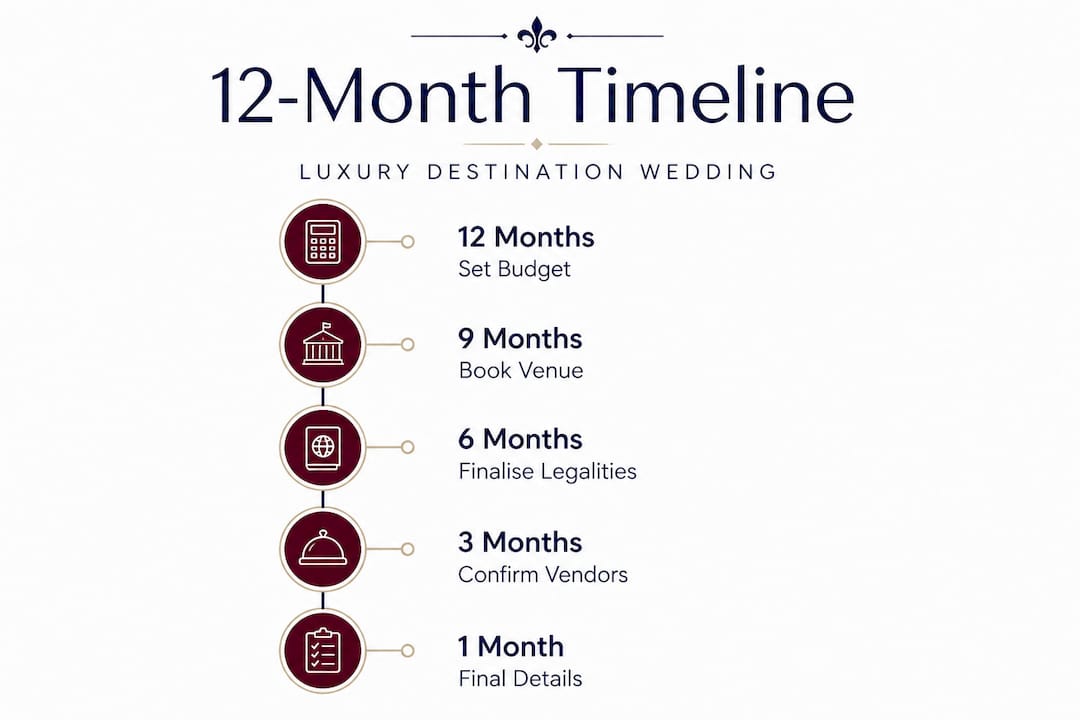
| Timeframe | Key milestones |
|---|---|
| 12 months out | Set budget, choose destination, begin legal research |
| 9 to 12 months | Book venue, send save-the-dates, secure room blocks |
| 8 to 9 months | Hire local planner, book photographer and videographer |
| 6 to 8 months | Confirm key vendors, arrange travel insurance |
| 4 to 6 months | Finalise décor and beverage design, send formal invitations |
| 2 to 4 months | Confirm RSVPs and headcount, finalise catering |
| 1 to 2 months | Final vendor calls, confirm logistics and contingency plans |
| Final weeks | Last-minute travel prep, welcome packs for guests |
Nine to twelve months out, you should send save-the-dates that include travel and accommodation information, book your venue and room blocks, hire your local planner, photographer, and key vendors. Waiting until six months out for any of these is a serious risk at premium venues.
Here is a numbered breakdown of the highest-priority actions in the first quarter of planning:
- Confirm your destination’s legal requirements for foreign nationals
- Set a realistic budget including travel for vendor site visits
- Choose your venue and secure it with a signed contract
- Send save-the-dates with a dedicated travel information page
- Negotiate group room blocks at nearby accommodation
- Begin researching local vendors including caterers and florists
- Decide on your overall design concept including luxury accents
Use the UK wedding timeline as a reference framework even for international events, adapting each milestone to your chosen country’s requirements. Our vendor checklist is equally valuable for identifying categories of supplier you might otherwise forget to book until it is too late.
Pro Tip: Build a buffer of four to six weeks into every vendor deadline. International contracts, translations, and payments always take longer than expected. What takes three days at home can take three weeks across borders.
Navigating legal and travel requirements
This is the section most couples skim over, and it is precisely where the most damaging surprises tend to occur. Legal requirements for getting married abroad vary enormously, and some countries require residency periods of up to three months before they will legally recognise a ceremony performed on their soil.
Research legal marriage requirements early, including passports, birth certificates, apostilles (officially certified document copies), residency periods, and whether you need a local officiant. Many couples wisely choose to hold a legal ceremony at home first, then celebrate with a symbolic ceremony abroad. This removes the bureaucratic burden entirely and lets you focus on the experience rather than the paperwork.
Here is a simplified comparison of how legal requirements differ across popular destination wedding countries:
| Country | Residency requirement | Apostille needed | Symbolic option popular? |
|---|---|---|---|
| Italy | Typically 1 to 3 days | Yes | Yes |
| Greece | Usually none | Yes | Yes |
| France | 30 to 40 days | Yes | Yes |
| Maldives | None | No | Very common |
| Mexico | Varies by state | Varies | Yes |
Key documents you will typically need for a fully legal ceremony abroad:
- Valid passports for both parties
- Full birth certificates (often translated and apostilled)
- Proof of single status or divorce decree if previously married
- Certificate of no impediment from your home country
- Any required residency documentation
Pro Tip: Use an luxury event hire guide mindset when approaching legalities. Just as a luxury service provider handles every detail of your beverage setup, consider hiring a specialist legal consultant for international marriage law. The cost is minimal compared to the risk of your ceremony having no legal standing.
Travel insurance is non-negotiable. Choose a policy that specifically covers wedding cancellation or postponement, vendor failure, and medical evacuation. Standard travel insurance rarely covers these scenarios, so read the fine print carefully. Identify a contingency plan for weather events and always have vendor backup contacts.
Designing an immersive luxury experience
Once your logistics and legal framework are in place, the most exciting stage begins: designing an experience that your guests will speak about for years. This is where destination weddings earn their reputation as the pinnacle of celebration.
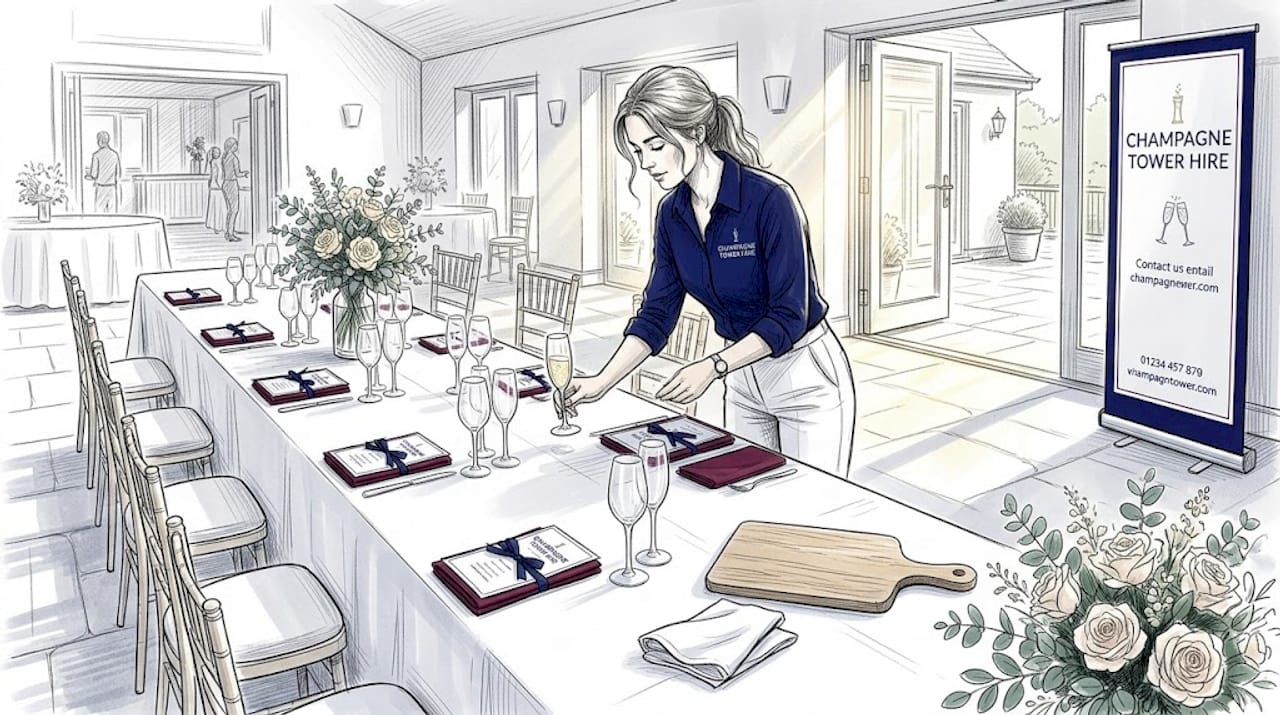
Luxury destination weddings often span multiple days, incorporate cultural immersion, and feature high-end venues like those in Tuscany where budgets commonly range from £120,000 to £400,000 for 100 guests. Every touchpoint from welcome drinks to farewell brunch contributes to the overall feeling of the celebration.
Multi-day celebrations are increasingly the norm for luxury destination weddings. A welcome evening with local cuisine, the main ceremony and reception day, and a relaxed farewell brunch the following morning create a complete arc of experience that a single-day event simply cannot match.
“The most memorable luxury weddings are not those with the biggest budgets. They are those where every moment felt considered, personal, and impossible to replicate.”
Key elements that elevate a destination wedding from beautiful to truly extraordinary:
- Custom beverage stations and champagne towers as visual centrepieces
- Locally sourced florals that reflect the destination’s natural palette
- Personalised welcome gifts in guest rooms upon arrival
- Curated local cultural experiences woven into the programme
- Atmospheric lighting that transforms the venue at dusk
- Bespoke printed materials including menus and order-of-service booklets
- Thoughtful dietary and accessibility provisions for all guests
Beverage displays deserve particular attention. A champagne tower or prosecco display is not merely a drink station — it is a visual statement, a conversation piece, and an experiential centrepiece that photographs brilliantly and signals to guests that this is a celebration of genuine quality. Stay current with luxury wedding trends to ensure your display choices feel fresh and inspired rather than predictable.
Refer to our luxury checklist to ensure your design choices align with the full scope of your event’s ambitions.
Key checklist for stress-free planning
With the timeline set, legalities understood, and design vision in place, you need a single, reliable checklist to keep everything on track. Here is a comprehensive, stage-by-stage summary:
- Vision and budget: Define your non-negotiables and maximum spend before you book anything.
- Destination research: Confirm accessibility, weather patterns, legal requirements, and peak seasons.
- Guest list and RSVPs: Set your invite list with a realistic attendance estimate and track responses rigorously.
- Venue contract: Read every clause, confirm cancellation terms, and ensure everything is in writing.
- Local planner: Hire a local destination planner who typically charges 10 to 15% of your total budget. This investment is essential for managing vendors, local laws, and logistical nuances that you simply cannot handle remotely.
- Vendor confirmation: Secure caterer, photographer, florist, entertainment, and beverage specialists.
- Travel and accommodation: Negotiate room blocks and provide guests with a clear booking link.
- Legal documents: Complete all required paperwork at least three months in advance.
- Luxury elements: Schedule and confirm your beverage displays, décor installations, and experiential touches.
- Contingency planning: Have a weather backup, vendor backup list, and emergency contact sheet.
Download or bookmark our luxury wedding to-do list for a shareable version of this checklist, and explore our wedding essentials list for additional detail on the finishing touches that make the biggest impression.
Pro Tip: Assign a point of contact among your guests — perhaps a well-organised friend or family member — who can answer travel and logistics questions on your behalf. This simple step saves hours of back-and-forth communication as your wedding date approaches.
Common mistakes to avoid include: failing to read vendor contracts fully before signing, assuming your home country legal paperwork is automatically valid abroad, underestimating guest attrition, and leaving luxury design elements like beverage displays as an afterthought rather than planning them as core features from the start.
What most couples (and many planners) overlook about destination weddings
Here is the honest truth: even the most thorough checklist cannot substitute for genuine local expertise and a mindset shift about what luxury actually means. We see it regularly. Couples spend months researching the perfect venue and then neglect the finer details that guests actually remember — the smoothness of the welcome, the warmth of the atmosphere, the moments of genuine surprise and delight.
Destination weddings tend to attract a particular kind of stress. Because everything is happening far from home, even small problems feel magnified. A local florist who is three hours late is a crisis when you have no nearby alternative. A legal document that is incorrectly certified can delay or invalidate your entire ceremony. These are not hypothetical risks — they happen frequently, and they happen most often to couples who planned everything correctly on paper but did not invest in the local human expertise to execute it.
The other thing most couples underestimate is guest engagement across a multi-day event. It is easy to plan one exceptional evening and then assume guests will entertain themselves the rest of the time. The couples who receive the most effusive praise from their guests are those who curate every shared moment — including the arrival experience, the morning after, and everything in between.
Our in-depth luxury checklist addresses this in detail, but the broader principle is this: luxury is not synonymous with spending more. It is about spending thoughtfully, choosing quality over quantity, and prioritising the guest experience over predictable photo opportunities. The memories your guests leave with are formed by how they felt, not by what they photographed.
Elevate your destination wedding with luxury beverage displays
Your destination wedding deserves every element of its design to be as breathtaking as the backdrop. At Champagne Tower Hire, we specialise in creating fully staffed, bespoke champagne and prosecco tower displays that transform any luxury celebration into something genuinely spectacular. A beautifully constructed champagne tower is not just a centrepiece — it is an experience, a moment of theatre, and a signal to your guests that every detail has been considered. Explore our elegant beverage display checklist to plan your display with confidence, and browse champagne tower inspiration to discover the styles and sizes that suit your vision perfectly.
Frequently asked questions
What documents do we need for a legal destination wedding?
You usually need valid passports, birth certificates, and apostilles or proof of residency depending on the country where you plan to marry.
How soon should we send save-the-date cards for our destination wedding?
Send save-the-dates nine to twelve months in advance so guests have ample time to plan travel and book accommodation at the best rates.
What percentage of guests can we expect to attend a destination wedding?
Expect 40 to 80% attendance based on your guest list size, destination accessibility, and the travel costs involved.
Why is hiring a local wedding planner recommended for luxury destination weddings?
A local planner manages vendors and legal nuances for approximately 10 to 15% of your total budget, reducing risk significantly compared to managing everything remotely.
Are luxury beverage displays practical for overseas weddings?
Yes — with thoughtful planning and local sourcing, beverage as an experiential focal point such as a champagne tower is entirely achievable and consistently ranks among the most memorable highlights of high-end destination celebrations.
Recommended
- Your ultimate destination wedding checklist for luxury
- The ultimate wedding venue checklist for a luxurious UK celebration – Champagne Tower Hire
- Your complete wedding vendor checklist for a luxurious UK celebration
- Small wedding planning checklist for UK couples 2026 – Champagne Tower Hire
- Destination Wedding Venues: Creating Unforgettable Celebrations


