

Creating an elegant champagne display that captivates guests while maintaining structural integrity presents a unique challenge for event planners. Whether you’re orchestrating an upscale wedding, corporate gala, or exclusive private celebration, mastering the art of champagne tower construction requires careful attention to glassware selection, precise engineering, and meticulous planning. This comprehensive guide walks you through every critical decision, from choosing the perfect coupes to calculating quantities and troubleshooting common pitfalls, ensuring your champagne display becomes the unforgettable centrepiece your clients deserve.
Table of Contents
- Selecting The Right Glassware For An Elegant Champagne Display
- Preparing The Champagne Tower Base And Structure For Stability
- Planning Champagne Quantities And Optimal Serving Conditions
- Troubleshooting Common Champagne Display Challenges And Finishing Touches
- Discover Expert Champagne Tower Hire And Bespoke Event Displays
- What Is The Ideal Glass Size For Champagne Towers?
- How Do I Ensure My Champagne Tower Is Stable And Safe?
- How Much Champagne Should I Prepare For A Large Tower?
- What Finishing Touches Elevate Champagne Displays Visually?
Key takeaways
| Point | Details |
|---|---|
| Glassware selection matters | Coupe glasses create superior cascading effects and reduce spills compared to flutes. |
| Base stability is critical | Square or rectangular bases with precise glass placement prevent collapses and ensure structural integrity. |
| Calculate for overflow | Plan five glasses per bottle to accommodate spillage and achieve complete tower filling. |
| Temperature affects experience | Serving champagne at 7-8°C preserves flavour profiles and maintains optimal effervescence throughout the event. |
| Finishing touches elevate impact | Strategic placement, lighting, and edible garnishes like flowers transform functional displays into showstopping centrepieces. |
Selecting the right glassware for an elegant champagne display
Having grasped the key considerations, we now focus on how to select the ideal glassware to elevate your display. Your choice of glassware fundamentally determines both the visual appeal and structural stability of your champagne tower. Understanding the nuances between different glass types helps you create displays that balance elegance with engineering.
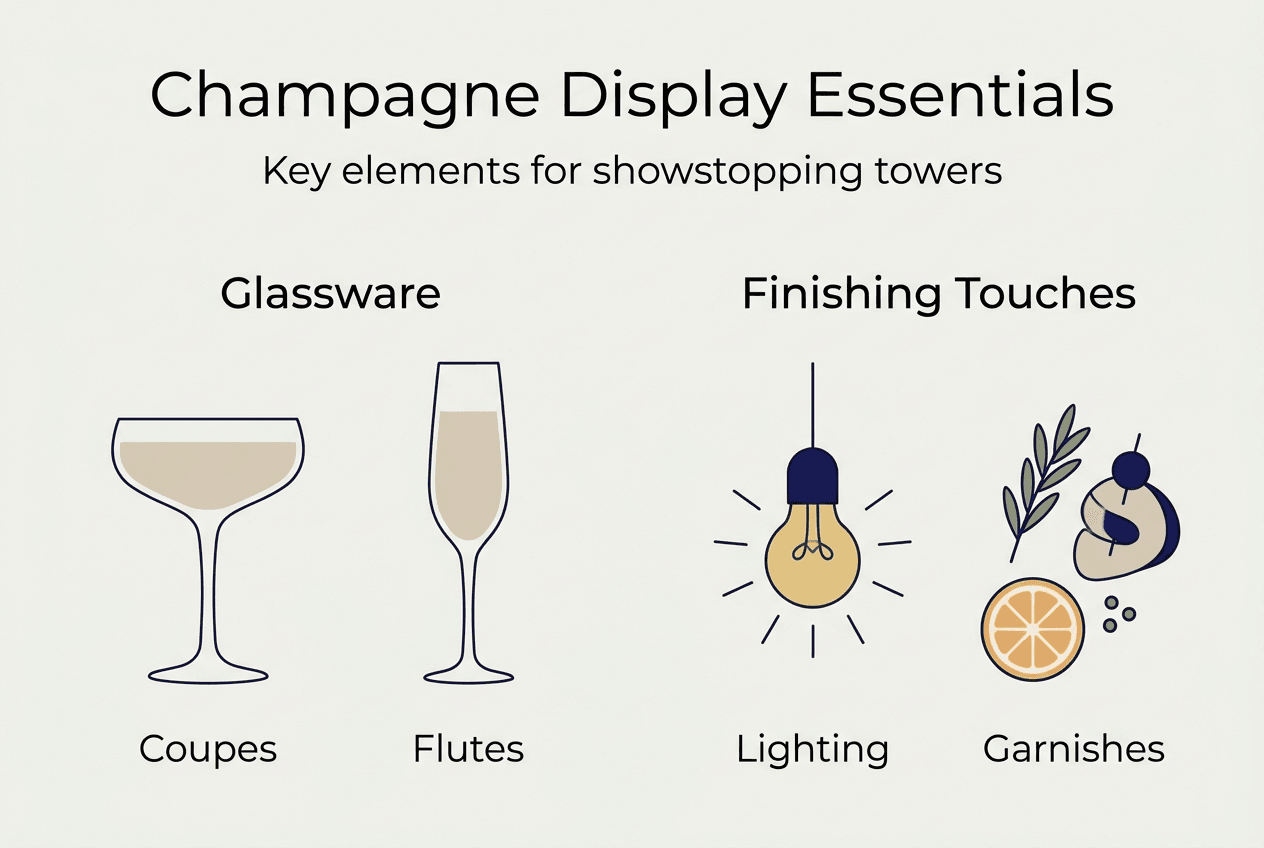
Champagne flutes typically range from 6 to 10 fluid ounces, designed to enhance the beverage’s effervescence and aromatic qualities. However, their narrow profile makes them challenging for tower construction. The tall, slender shape increases instability as tiers rise, and the limited surface area restricts the cascading effect that makes champagne towers so visually spectacular.
Coupe glasses prove ideal for champagne towers due to their wider bowl shape facilitating superior cascading effects whilst significantly reducing spills. The broader rim allows champagne to overflow evenly across multiple glasses, creating that mesmerising waterfall effect guests expect. Ornate coupes with etched patterns or decorative stems catch ambient lighting beautifully, transforming your tower into a shimmering focal point that photographs exceptionally well.
Wine glasses offer an alternative worth considering when you want guests to appreciate the champagne’s bouquet and flavour complexity more fully. Their larger bowl allows aromas to develop, though this comes at the cost of reduced structural stability for tower construction. Reserve wine glasses for smaller displays or tableside service rather than ambitious multi-tier structures.
When exploring choosing the right glass for your champagne tower hire, avoid mixing glass types within a single tower. Inconsistent dimensions create uneven weight distribution, dramatically increasing collapse risk. Similarly, steer clear of glasses with decorative elements that might catch or snag during assembly.
Pro Tip: Select glassware that balances visual elegance with structural safety by testing a small three-tier prototype before your event. This reveals potential stability issues and helps you refine glass placement techniques without risking a catastrophic collapse during the actual celebration.
Your glassware selection complete guide should account for your venue’s lighting conditions. Crystal glasses create stunning refractions under spotlights, whilst simpler designs work better in naturally lit spaces. Consider how glass types for champagne towers uk standards align with your event’s aesthetic, ensuring every element contributes to a cohesive, luxurious atmosphere.
Preparing the champagne tower base and structure for stability
With the ideal glassware chosen, let’s examine how to build a sturdy and impressive champagne tower base. Structural integrity depends on precise glass placement and even weight distribution, with a square or rectangular base crucial for preventing catastrophic failures. Your foundation determines whether your tower becomes an Instagram-worthy centrepiece or an expensive disaster.
Begin by selecting a perfectly level surface. Even slight inclines cause champagne to pool unevenly, creating dangerous weight imbalances as you build upwards. Professional event tables work well, but always verify levelness with a spirit level before placing your first glass. The table itself must support considerable weight, a six-tier tower with champagne can exceed 30 kilograms.
For a six-tier tower, start with a 6×6 glass base comprising 36 coupes arranged in perfect rows. Each subsequent tier decreases by one glass per side: your second tier uses 5×5 glasses (25 total), third tier 4×4 (16 glasses), continuing until your top tier features a single glass. This pyramidal structure distributes weight efficiently whilst creating the classic champagne tower silhouette.
| Tier Level | Grid Size | Glass Count | Running Total |
|---|---|---|---|
| Base (Tier 1) | 6×6 | 36 | 36 |
| Tier 2 | 5×5 | 25 | 61 |
| Tier 3 | 4×4 | 16 | 77 |
| Tier 4 | 3×3 | 9 | 86 |
| Tier 5 | 2×2 | 4 | 90 |
| Tier 6 | 1×1 | 1 | 91 |
Place each glass with deliberate precision. Position glasses so their bases rest securely in the valleys formed by the four glasses below, creating natural stability points. Never rush this process, a single misaligned glass compromises the entire structure. Work methodically from one corner, completing each row before starting the next.
Champagne tower failures mostly arise from unstable bases, incorrect glass placement, and uneven pouring leading to risks and damage. Common mistakes include using tables with slight wobbles, placing towers near high-traffic areas where guests might bump them, or building on surfaces affected by air conditioning drafts that cause subtle vibrations.
Pro Tip: Place a non-slip mat beneath your base tier glasses to prevent microscopic shifting during construction and pouring. This simple addition dramatically improves stability, especially on polished surfaces where glasses might slide imperceptibly.
When learning how to set up champagne tower structures, always build from the outside edges inward for each tier. This technique lets you verify alignment continuously without reaching awkwardly over completed sections. For guidance on create bespoke champagne towers that match specific event themes, consider how base dimensions affect overall visual impact in your venue’s space.
Planning champagne quantities and optimal serving conditions
Now that your tower is built solidly, let’s ensure the champagne quantities and serving conditions match your event’s grandeur. Accurate calculation prevents the embarrassment of running short mid-pour or the waste of excessive leftovers. Understanding the mathematics behind champagne service transforms good planning into flawless execution.
Calculate bottle requirements based on five glasses per bottle to allow for overflow and spills that characterise tower pours. Standard 75cl bottles yield approximately five servings when accounting for the generous overflow essential to creating that cascading waterfall effect. For a 91-glass tower, you’ll need roughly 18-19 bottles, though ordering 20 provides a comfortable safety margin.
| Total Glasses | Bottles Needed (÷5) | Recommended Order |
|---|---|---|
| 50 | 10 | 11 bottles |
| 75 | 15 | 16 bottles |
| 91 | 18.2 | 20 bottles |
| 120 | 24 | 25 bottles |
| 150 | 30 | 32 bottles |
Magnum 150cl bottles prove ideal for consistent flow and visual impact, reducing refill needs during the pour. A single magnum equals two standard bottles, delivering uninterrupted cascades that photograph beautifully. The substantial bottle size also adds theatrical flair when the host initiates the pour, creating a memorable moment guests discuss long after your event concludes.
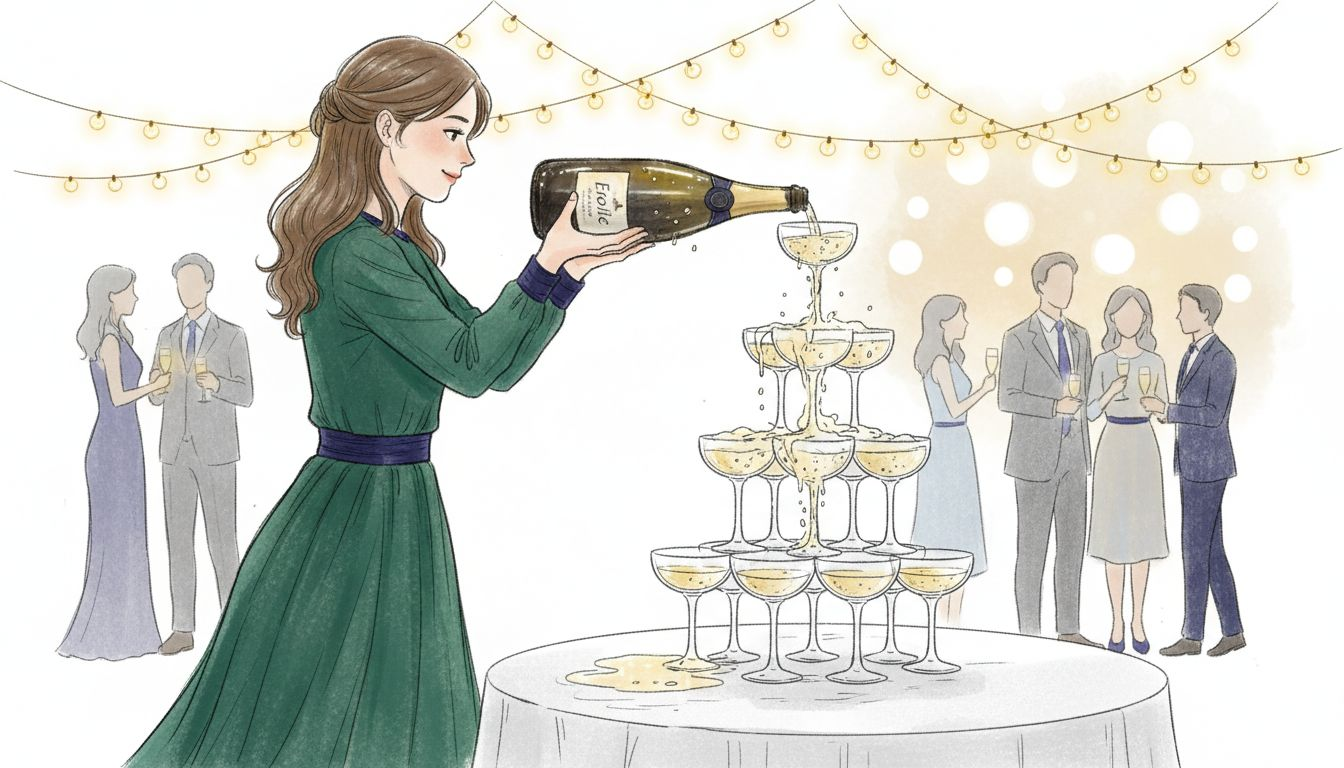
Serving temperature significantly affects both flavour and the pouring experience. Champagne served at 7-8°C maintains optimal effervescence whilst allowing the wine’s complex aromatics to develop properly. Temperatures below 6°C suppress flavour notes, whilst anything above 10°C causes excessive foaming that complicates tower filling and wastes champagne through overflow.
Implement these serving best practices for superior guest satisfaction:
- Chill bottles for at least four hours before service, using ice buckets for final temperature adjustment
- Store backup bottles in a dedicated refrigerator or cooler, never in ice that might cause labels to deteriorate
- Open bottles carefully to preserve carbonation, avoiding dramatic cork pops that release excessive CO2
- Pour steadily from 15-20cm above the top glass, maintaining consistent flow for even distribution
- Have staff positioned to catch drips with napkins, protecting tablecloths and flooring from stains
For create bespoke champagne towers that incorporate specific champagne varieties, research each wine’s unique characteristics. Vintage champagnes often produce finer bubbles requiring gentler pours, whilst prosecco’s more robust effervescence cascades beautifully but may need slightly cooler serving temperatures to control foam.
Your private party champagne planning guide should account for ambient temperature at outdoor events. Summer celebrations may require additional ice and more frequent bottle rotation to maintain ideal serving conditions throughout the evening.
Troubleshooting common champagne display challenges and finishing touches
With this troubleshooting knowledge and styling advice, your champagne display will be both stunning and safe. Even meticulously planned towers encounter unexpected challenges, and knowing how to respond quickly prevents minor issues from escalating into memorable failures.
Uneven pouring represents the most frequent problem, causing champagne to pool heavily on one side whilst leaving other sections inadequately filled. This weight imbalance stresses glass stems and increases toppling risk. Solve this by pouring in slow, circular motions rather than directing flow to a single point. If pooling occurs, pause pouring and use a small ladle to redistribute champagne more evenly across the top tier before continuing.
Glass misplacement becomes apparent only when champagne begins flowing, revealing gaps or unstable contact points between tiers. If you notice wobbling during the pour, stop immediately and assess whether you can safely adjust glasses or must abort the cascade. Never attempt to reposition glasses once champagne is flowing, the combination of wet surfaces and applied pressure virtually guarantees collapse.
Unstable surfaces cause progressive deterioration as champagne weight accumulates. Symptoms include subtle leaning or glasses beginning to slide microscopically. Address surface instability before building by:
- Verifying table legs are fully extended and locked
- Checking floor levelness and using shims if necessary
- Ensuring the table isn’t positioned over carpet seams or uneven flooring
- Confirming no one can accidentally kick table legs during service
Improper champagne tower construction poses genuine safety risks beyond mere embarrassment. Collapsing towers can cause cuts from broken glass, champagne in eyes requiring medical attention, and damaged clothing leading to compensation claims. Professional liability insurance should cover champagne service at events where you’re providing this element.
Pro Tip: Adding edible flowers or strawberries enhances visual appeal and sophistication, but add these garnishes before assembly, never after glasses are positioned. Trying to garnish a completed tower risks destabilising the structure.
Choosing a secure, visible location maximises stability and guest experience by ensuring your tower becomes a focal point without compromising safety. Position towers at least two metres from dance floors, DJ equipment, or anywhere guests congregate densely. Elevated platforms work beautifully for visibility but require extra stability measures and safety barriers preventing guests from leaning against the display.
Lighting transforms good champagne towers into extraordinary ones. Position spotlights to create dramatic shadows and highlight the champagne’s golden hues as it cascades. Uplighting from beneath (using LED units that don’t generate heat) makes the tower glow ethereally, whilst strategic side lighting emphasises the tower’s architectural qualities. Avoid overhead lighting alone, which flattens the display and fails to showcase the champagne’s movement.
For champagne towers with flowers, coordinate floral colours with your event’s palette whilst ensuring blooms are pesticide-free and non-toxic. Roses, orchids, and edible pansies work beautifully, but avoid flowers with heavy pollen that might fall into glasses. Understanding beverage display styling impact helps you make choices that photograph well and align with your event’s overall aesthetic vision.
Discover expert champagne tower hire and bespoke event displays
After mastering how to create showstopping champagne displays, effortless professional help is just a click away. Whilst this guide equips you with comprehensive knowledge, executing flawless champagne towers consistently requires experience, specialised equipment, and the confidence that comes from hundreds of successful installations. That’s where professional champagne tower hire uk services deliver exceptional value.
Luxury champagne tower hire across the UK provides access to pristine glassware, expert setup teams, and comprehensive insurance coverage that protects you from liability. Professional services handle every detail, from calculating precise quantities to managing the actual pour, allowing you to focus on other critical event elements. Bespoke design options let you create bespoke champagne towers tailored perfectly to your event’s theme, incorporating custom heights, unique glass selections, and coordinated styling elements.
Expert support ensures flawless execution from initial consultation through teardown. Experienced professionals anticipate challenges before they arise, adjusting for venue-specific factors like uneven flooring, ambient temperature fluctuations, or spatial constraints. For events incorporating champagne towers with flowers guide elements, professional services coordinate with your florist to achieve seamless integration that elevates the entire display.
What is the ideal glass size for champagne towers?
Champagne flutes typically range from 6 to 10 fluid ounces to enhance characteristics, but coupes generally work better for tower construction. The 6-8 fluid ounce range balances elegance with functionality, providing sufficient capacity for cascading whilst maintaining manageable weight per glass. Larger glasses increase structural demands exponentially as tiers rise, whilst smaller glasses require more units to achieve impressive visual scale, complicating construction and increasing costs.
How do I ensure my champagne tower is stable and safe?
Structural integrity depends on base stability, correct glass placement, and even pouring throughout the filling process. Always use a square or rectangular base on a verified level surface, checking with a spirit level before beginning assembly. Place each glass precisely in the valleys formed by supporting glasses below, and pour champagne in steady, circular motions to distribute weight evenly across all tiers rather than concentrating flow in one area.
How much champagne should I prepare for a large tower?
Calculate based on five glasses per bottle to allow for overflow and ensure complete filling of your entire structure. Count your total glasses, divide by five, then round up to the nearest whole number for your bottle order. Always add 10-15% extra bottles as a safety margin, accounting for potential spillage during setup, guest servings after the tower pour, and the possibility of a bottle being corked or otherwise unsuitable for service.
What finishing touches elevate champagne displays visually?
Adding edible flowers or strawberries enhances visual appeal and sophistication when incorporated thoughtfully into your design. Choose lighting carefully to highlight the champagne’s golden tones and the tower’s architectural qualities, using spotlights or uplighting rather than flat overhead illumination. Position your tower in a prominent, secure location where it serves as a natural focal point without competing with other design elements or creating safety hazards in high-traffic areas.
Recommended
- How to Serve Champagne at Events with Perfect Elegance
- Champagne Displays: Everything You Need to Know
- Step by Step Champagne Display for Elegant Events
- How to Style Champagne Display for Luxurious Events
- 6 Best Print Materials for Events: Maximize Branding Impact – www.printcafeusa.com
- Cake display fridge 1800mm – EcoFrost Hvac


