

For most UK events, a staffed, full-service champagne tower hire package is the right choice. It covers installation, supervised pouring, breakdown, and insurance in a single booking. Small gatherings suit a 4-tier tower; weddings and corporate events with larger guest counts typically need a 5- or 6-tier structure; larger branded occasions call for a bespoke display built around your specific brief.
- Wedding centrepiece or corporate toast: a staffed tower creates a focal moment that a standard drinks reception simply cannot replicate.
- Branded product launches or VIP activations: a bespoke tower with acrylic panels and coordinated florals delivers a visual impact that photographs and films beautifully.
- Intimate private celebrations: a smaller hire with a deliver-and-leave option keeps costs proportionate without sacrificing the spectacle.
Under the Consumer Rights Act 2015, any service provider must perform their work with reasonable care and skill, which means the assembly, glassware quality, and conduct of the setup team all carry legal weight. Request an instant quote from Champagnetowerhire to get a clear cost before you commit to anything.
Table of Contents
- What do champagne tower hire packages usually include?
- How do you choose the right tower size and calculate bottles?
- What styling options can you add to a champagne tower?
- What drives the cost of champagne tower hire?
- What safety checks and contract terms should you insist on?
- Key takeaways
- When does a champagne tower actually earn its place?
- Champagnetowerhire: bespoke towers, staffed setup, instant quotes
- Useful sources for contracts, insurance and glassware standards
What do champagne tower hire packages usually include?
Most suppliers structure their offering across three broad service tiers, and understanding the differences helps you shortlist quickly.
Small packages (60–100 glasses) typically include a 4-tier tower, a set of matching flutes or coupes, the structural plinth, delivery, installation, and collection. Staffing at this level is often a single attendant who sets up, supervises the pour, and packs down.
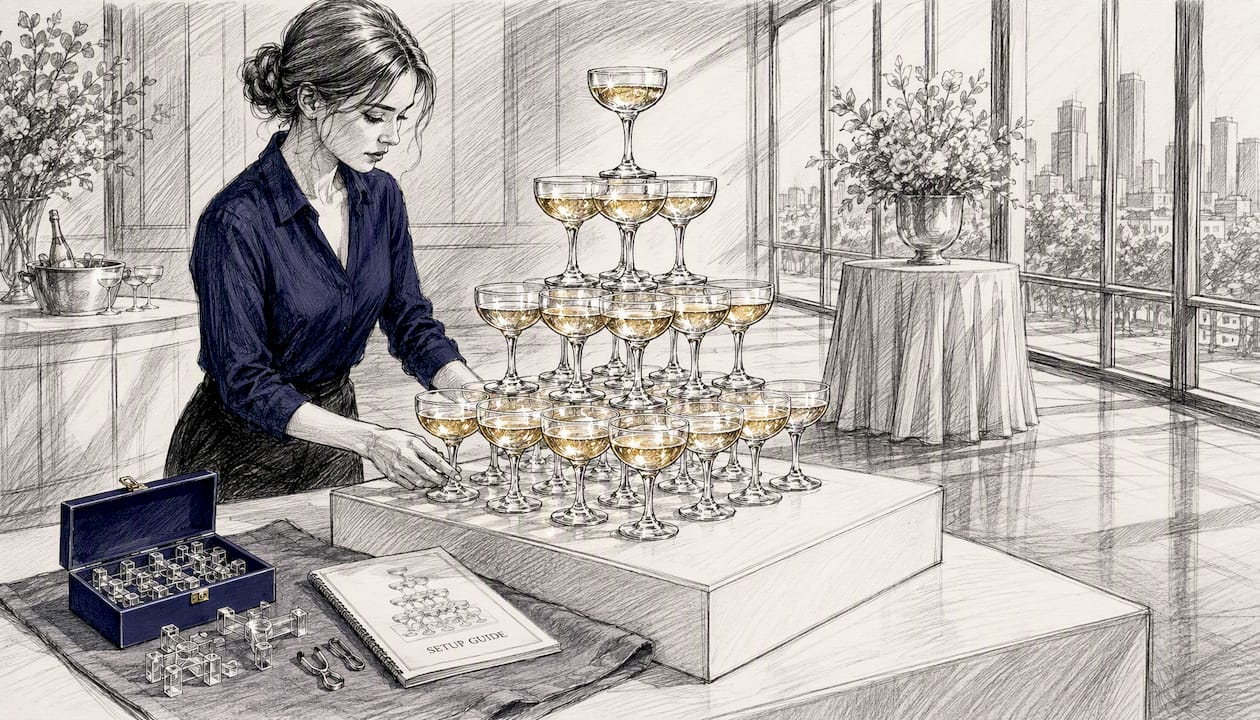
Medium packages (120–300 glasses) add more tiers, a larger plinth, and usually a dedicated presenter who manages the pour ceremony. These packages suit weddings and corporate dinners where the tower is the centrepiece of a drinks reception. Wedding champagne tower packages at this scale often include a free instant online quote so you can plan your budget before speaking to anyone.
Large and bespoke packages (300+ glasses or branded displays) are built around your event brief. Expect a full presentation team, branded acrylic panels, coordinated florals, LED uplighting, and a master of ceremonies to manage the pour. Transportation, insurance, and venue-specific risk assessments are included as standard with reputable providers.
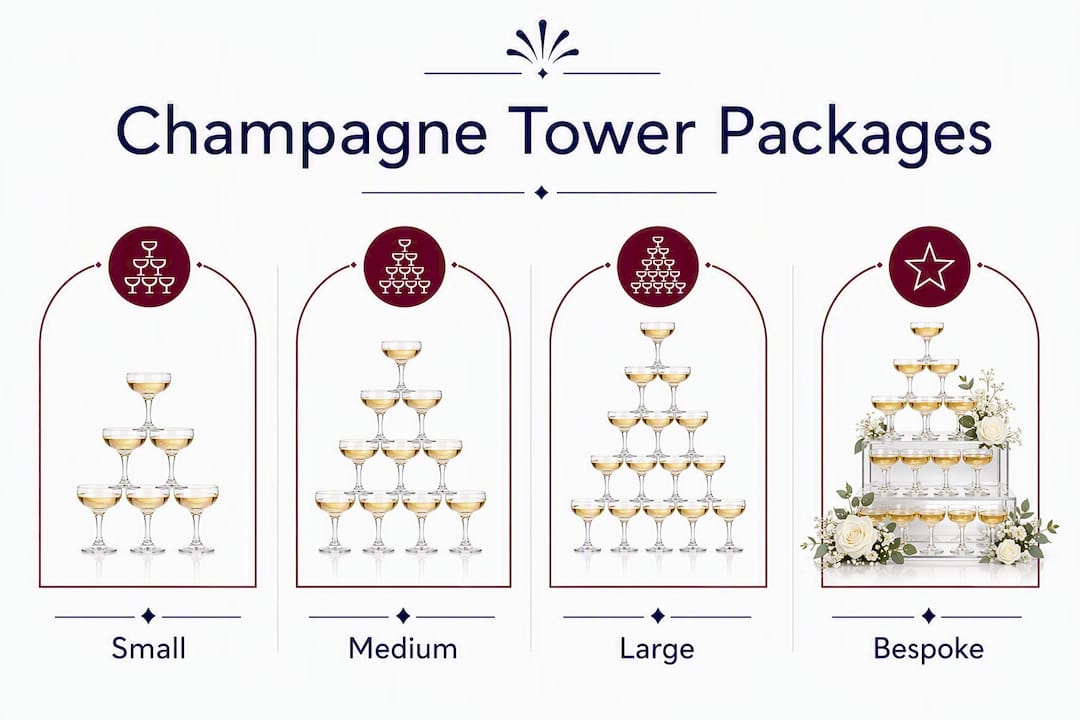
Across all tiers, the standard inclusions to confirm are: glassware, the tower structure and plinth, installation and supervised pouring, breakdown and cleaning, and transport. Optional add-ons include a premium champagne upgrade (versus prosecco or cava), fresh florals, branded acrylic panels, fairy lighting, strawberries or petit fours, and client-supplied beverage options where the venue permits.
Pro Tip: If your venue operates under a ‘no-glass’ licence condition, raise this at quote stage. A reputable supplier will offer toughened polycarbonate as a documented alternative rather than leaving you to discover the restriction on the day.
How do you choose the right tower size and calculate bottles?
Sizing a tower correctly is a straightforward calculation once you know the formula.
- Establish total glass capacity: glasses per tier × number of tiers = total glasses available.
- Decide the proportion of guests to serve from the tower: most planners target 40–60% of the total guest count for the tower pour, with the remainder served from trays.
- Calculate bottles required: divide the number of glasses to be served by the average pours per bottle (typically 5–6 pours per 75cl bottle of champagne or prosecco).
- Add a contingency reserve: round up to the nearest case and hold back at least one spare bottle per 50 tower glasses.
Worked example for a 200-guest wedding using a 6-tier tower:
- a 6-tier tower holds a typical number of glasses aligning with its size
- serving a moderate proportion of the total guests from the tower
- calculate bottles required by dividing glasses to serve by average pours per bottle
- add a contingency amount when ordering bottles
| Tower size | Approximate glasses | Suggested guest range |
|---|---|---|
| 4-tier | suitable glass capacity | typically for smaller guest counts |
| 5-tier | suitable glass capacity | typically for mid-sized guest counts |
| 6-tier | suitable glass capacity | typically for larger guest counts |
| 7-tier | suitable glass capacity | for the largest guest counts |
Quick checks before confirming your size: available floor space, ceiling height adequate for the tower size, loading access for delivery, and whether the venue’s floor surface is level and load-bearing.
Pro Tip: Round up your bottle order and plan one spare attendant for every 200–300 guests when the tower is the primary pour. Running short of either mid-ceremony is the one thing no amount of styling can recover.
What styling options can you add to a champagne tower?
Glass choice shapes the guest experience before a drop is poured. The three main formats each have a genuine trade-off:
- Flute: concentrates carbonation and looks striking in a tower stack, but restricts aroma.
- Tulip: preserves carbonation and improves aroma compared with the coupe, and is increasingly preferred for fine dining settings.
- Coupe: the classic retro silhouette that photographs beautifully, but loses carbonation faster than either alternative.
For material, crystal or high-quality soda-lime glass suits premium indoor events. Where a venue licence demands unbreakable materials, toughened glass or polycarbonate offers higher impact resistance and satisfies most local authority conditions without sacrificing the visual effect.
Beyond glassware, the aesthetic add-ons that most consistently lift a tower display are:
- Coloured stems or tinted glass to match a wedding colour palette
- Branded acrylic panels for corporate product launches or award ceremonies
- Coordinated fresh florals woven around the plinth (lead time: typically 2–3 weeks for bespoke arrangements)
- Fairy lighting or LED uplighting beneath the plinth for evening receptions
- Strawberries, edible flowers, or petit fours arranged at the base for a food-pairing moment
For bespoke champagne tower designs, the styling brief needs to be confirmed at least four weeks before the event date to allow for sourcing and production. Corporate branding on acrylic panels usually requires artwork files two weeks ahead.
Pro Tip: Where a venue’s licence mandates ‘no glass’, get that confirmation in writing from the venue and pass it to your supplier at quote stage. A marked polycarbonate alternative should appear explicitly on the hire contract, not as a verbal assurance.
What drives the cost of champagne tower hire?
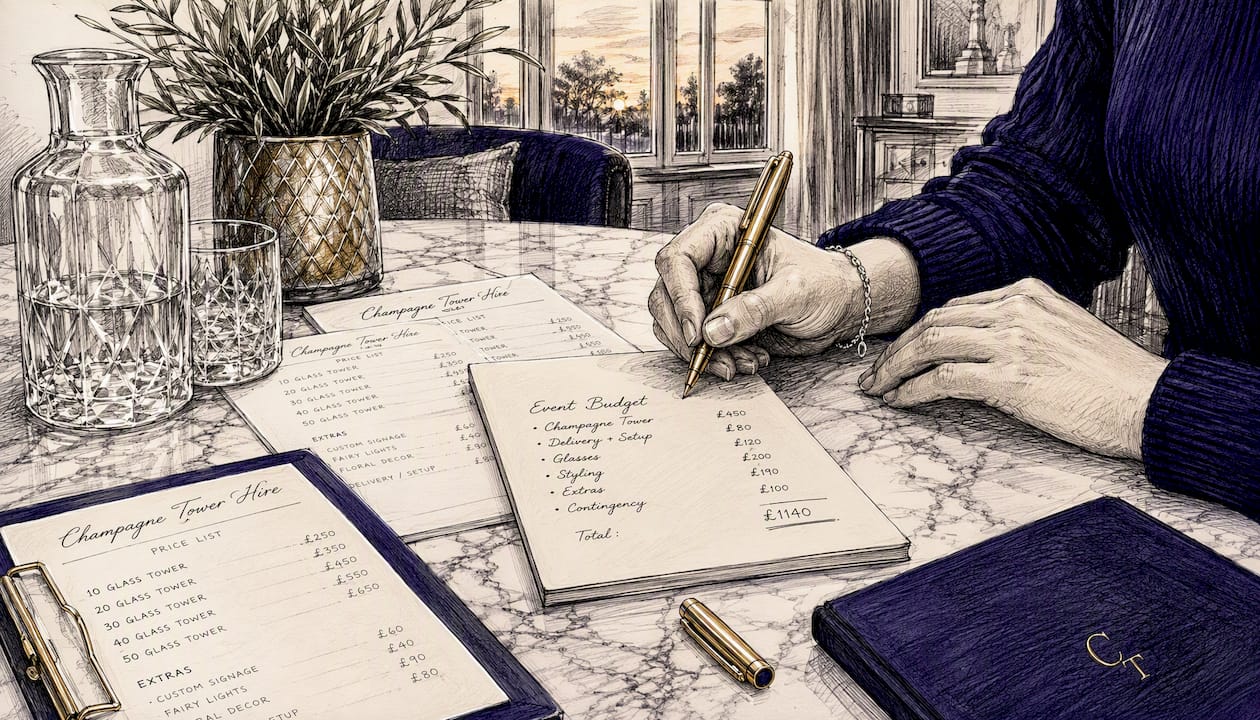
Pricing varies considerably, and the most useful thing you can do is normalise every quote to a per-glass or per-guest figure so you are comparing like for like.
The main cost drivers are:
- Tower size and glass count: more tiers mean more glassware, a larger plinth, and longer installation time.
- Staffing hours: a supervised presentation with a dedicated attendant costs more than a deliver-and-leave arrangement.
- Drink supplied: a champagne upgrade from prosecco or cava adds cost per bottle; some packages allow client-supplied beverages, which changes the pricing structure.
- Travel and mileage: most UK suppliers apply a mileage rate beyond a base radius; confirm this before comparing headline prices.
- Bespoke styling and branding: florals, branded acrylic, and LED lighting are typically priced as add-ons.
- Insurance and venue-specific surcharges: some venues charge a supplier fee or require additional public liability cover.
When requesting a quote, ask for the following in writing: the starting cost and what it includes, every exclusion, travel fees and the basis on which they are calculated, the deposit amount and payment schedule, and the cancellation terms with specific date bands. Good practice for cancellation terms is to map refund rules to clear time bands, such as more than 90 days, 30–90 days, and fewer than 30 days before the event.
An instant online quote system removes the guesswork. Rather than waiting for a bespoke proposal, you get a transparent cost estimate based on your specific event parameters, which makes budget planning far more straightforward.
What safety checks and contract terms should you insist on?
This is where many planners underinvest their attention, and it is where disputes most often arise.
The legal baseline: under the Consumer Rights Act 2015, services must be performed with reasonable care and skill. Consumers in England, Wales and Northern Ireland have remedies including a re-do, price reduction, or refund where services fall short. For a physical installation like a champagne tower, that covers structural assembly, glassware quality, and the professional conduct of the setup team.
Safety checklist before the event:
- Structural stability check of the tower and plinth on the venue floor
- Glass type confirmed as approved by the venue (or polycarbonate documented as the alternative)
- Safe access route confirmed for delivery and installation
- Slip-and-spill controls in place around the tower base
- Supervised pouring protocol agreed with the attendant
- Documented staff training records available on request
Contract clauses to request:
- Clear scope of work with set-up and pack-down times specified
- Definition of ‘material change’ and what triggers a renegotiation
- Deposit amount, payment schedule, and refund mechanics for each cancellation band
- Liability and indemnity limits, with the supplier’s insurance certificate attached
- Confirmation of who holds responsibility for venue licence compliance
Venue contracts frequently leave licence compliance ambiguous unless the booking explicitly names the responsible party. The same principle applies to your supplier contract: specify who pays for additional venue charges or fines arising from non-compliance.
For insurance, confirm the supplier carries public liability cover and employer’s liability cover, and ask whether the certificate can name the client or venue where required. Trading Standards guidance confirms that consumer fairness rules affect cancellation charges for consumer-facing bookings with a specific performance date.
Pro Tip: Add a short clause to the contract specifying which party is responsible for compliance with the venue’s licence conditions and which party covers any resulting fines or additional venue charges to help prevent disputes.
Key takeaways
A staffed, full-service champagne tower hire package matched to your guest count, venue rules, and styling brief is the most reliable choice for UK weddings, corporate events, and private celebrations.
| Point | Details |
|---|---|
| Match tower size to guest count | Use the 4-to-7-tier table to align glass capacity with the proportion of guests you plan to serve from the tower. |
| Confirm venue glass policy early | Ask the venue about ‘no-glass’ licence conditions before finalising glassware; request polycarbonate in writing if required. |
| Normalise quotes per guest | Divide each quote’s total cost by the number of guests served to compare suppliers on equal terms. |
| Request contract specifics | Insist on cancellation bands, deposit mechanics, liability limits, and a named party for venue licence compliance. |
| Champagnetowerhire | Offers bespoke towers, staffed installations, styling add-ons, and an instant online quote for weddings and corporate events across the UK. |
When does a champagne tower actually earn its place?
A tower works best when it is the event’s focal moment, not a background feature. Evening wedding receptions, product launches where the brand needs a visual centrepiece, and VIP corporate activations where the pour is part of the programme: these are the scenarios where the spectacle justifies the logistics. The tower becomes the photograph, the shared memory, the thing guests talk about on the way home.
There are situations where a simpler drinks display is the smarter call. Venues with strict ceiling height or load-bearing restrictions may not accommodate a 6- or 7-tier structure safely. Very large standing receptions, where guests circulate freely, can find a static tower creates a bottleneck rather than a moment. Events with tight turnaround times between ceremony and reception sometimes cannot accommodate the installation window a tower requires.
The honest planner’s question is not “would a tower look good?” but “does this event have the space, the timeline, and the guest flow to let the tower perform?” When the answer is yes, nothing else in the drinks display category comes close for visual impact. When the answer is uncertain, a champagne fountain or prosecco display can deliver a similar celebratory feel with fewer logistical constraints. The spectacle should serve the event, not the other way around.
Champagnetowerhire: bespoke towers, staffed setup, instant quotes
Champagnetowerhire delivers what most planners actually need: a single supplier who handles the tower, the staff, the styling, and the logistics, with transparent pricing from the first moment you enquire. The instant online quote gives you a real cost based on your event parameters, not a holding figure that changes after three emails.
- Sizes available: 4-tier through to large bespoke displays for 300+ guests
- Staffed presentation: trained event specialists install, supervise, and pack down
- Insurance cover: public liability included; certificates available for venues on request
- Styling options: florals, branded acrylic, LED uplighting, polycarbonate alternatives for licence-restricted venues
- Credibility: award-winning service with verified client testimonials and documented safety checks
Check availability for your date, confirm the booking timeline and deposit terms, then request your quote. Bespoke styling and peak-season dates fill quickly, so the earlier you confirm, the more options remain open.
Useful sources for contracts, insurance and glassware standards
- Consumer Rights Act 2015: the legal baseline for service standards in England, Wales and Northern Ireland; covers remedies where a service is not performed with reasonable care and skill.
- Consumer Rights Act: Services — Guidance for Business (Trading Standards): practical guidance on cancellation charges, deposit fairness, and date-specific service contracts; most useful when reviewing a supplier’s booking terms.
- Refund and cancellation terms for UK event companies (Sprintlaw): explains how cancellation bands, deposit mechanics, and third-party cost clauses should be structured; use this when comparing supplier contracts.
- Key contract risks for event venues in the UK (Sprintlaw): covers scope of hire, licence compliance responsibility, and access terms; relevant when confirming venue-side obligations alongside your tower hire contract.
- Hospitality glassware UK: buying guide (We Can Source It): trade-offs between flute, coupe, and tulip formats, plus guidance on polycarbonate for outdoor or licence-restricted settings.
- UK hospitality glassware safety standards (Ascot Wholesale): toughened glass and polycarbonate recommendations for high-risk or festival environments; useful when a venue licence demands unbreakable materials.


