

Planning a champagne tower for your wedding or party sounds glamorous, and it absolutely is. But ask most event organisers how many glasses they actually need, and you’ll find a surprising amount of guesswork involved. The truth is, there’s no single universal answer. The ideal glass count depends on your tier structure, your guest list, and a touch of mathematics that most people never expect. This guide cuts through the confusion, giving you clear, practical answers rooted in UK event experience so you can plan your tower with total confidence.
Table of Contents
- Understanding champagne tower structure
- How to calculate glass count for your champagne tower
- Selecting the right tower for your guest count
- Essential tips for a flawless champagne tower
- Common pitfalls and safety guidelines
- Make your event unforgettable with professional champagne towers
- Frequently asked questions
Key Takeaways
| Point | Details |
|---|---|
| Glass count by tiers | Use the sum of squares formula to work out exactly how many coupe glasses you need for your champagne tower. |
| Size for your event | Match your tower to your guest count—smaller for intimate parties, larger for weddings and big events. |
| Choose the right glasses | Wide champagn coupe glasses and careful pouring are key to stability and photo-ready results. |
| Safety for tall towers | For displays over 7 tiers, professional help ensures compliance and prevents costly mishaps. |
Understanding champagne tower structure
Before you order a single glass, it helps to understand why champagne towers are built the way they are. The classic design follows a square pyramid structure, where each tier is a square grid of glasses stacked on top of the one below. This isn’t just for aesthetics. The shape distributes weight evenly and allows champagne to cascade beautifully from the top glass downward.
As pyramid structures follow the sum of squares formula, each tier adds a squared number of glasses. Tier one (the top) holds 1 glass, tier two holds 4, tier three holds 9, and so on. The total climbs quickly, which surprises many first-time planners.
Here’s a quick reference for standard tower counts:
Standard glass counts by tier:
3-tier: 14 glasses | 4-tier: 30 glasses | 5-tier: 55 glasses | 6-tier: 91 glasses
Coupe glasses are the only sensible choice for this build. Their wide, shallow bowls sit flush against each other, creating stability that tall flutes simply cannot match. Uniform sizing is equally important. Mixed glass sizes cause uneven weight distribution and increase the risk of collapse.
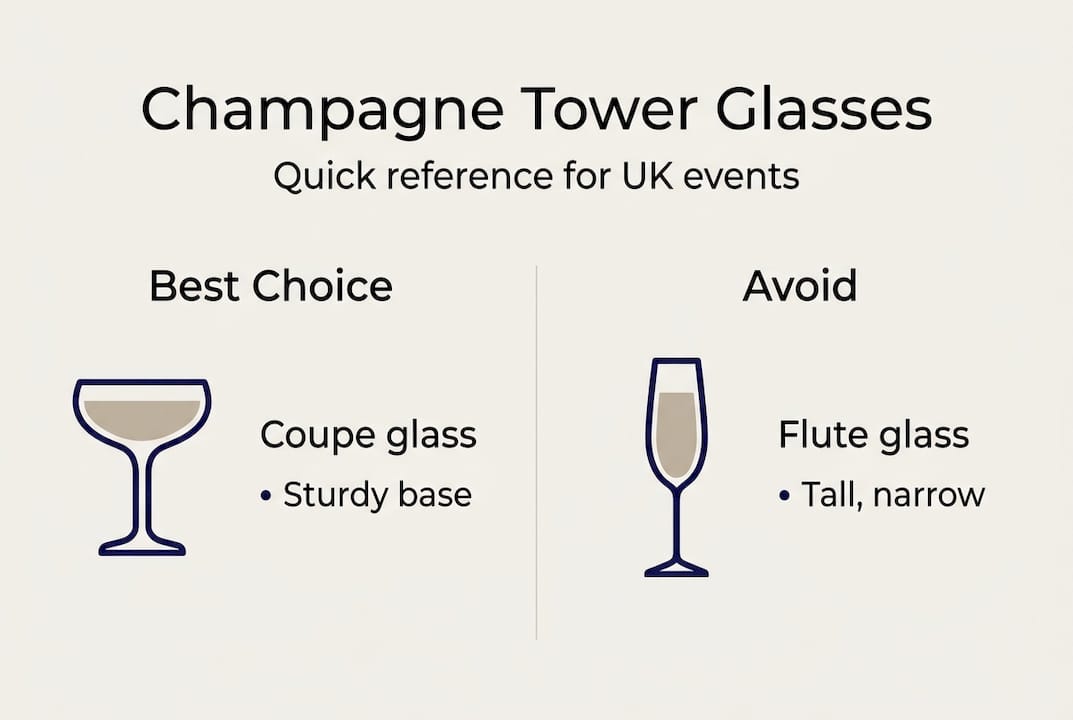
When choosing your tower size, always order more glasses than your tier count requires. Spares protect you against breakages during setup and give you flexibility if you decide to expand the design on the day.
Pro Tip: Order at least 15% more glasses than your target tier count. It costs very little extra and saves enormous stress on the day.
Non-square or circular base configurations do exist, but they complicate the pour and the structural integrity. For most UK weddings and parties, the classic square pyramid remains the gold standard.
How to calculate glass count for your champagne tower
Now that you understand the structure, let’s turn that knowledge into a workable number for your event. The sum of squares formula is straightforward: add together the squares of each tier number from 1 up to your chosen tier count.

For a 5-tier tower: 1 + 4 + 9 + 16 + 25 = 55 glasses. Simple, once you know the rule.
Here’s a full reference table covering the range of UK event sizes:
| Tiers | Glasses needed | Approx. bottles required |
|---|---|---|
| 3 | 14 | 3 |
| 4 | 30 | 5 |
| 5 | 55 | 10 |
| 6 | 91 | 16 |
| 7 | 140 | 24 |
| 8 | 204 | 35 |
| 9 | 285 | 48 |
| 10 | 385 | 65 |
For planning your champagne tower around your guest list, here’s a practical breakdown by event type:
- Intimate gathering (up to 30 guests): A 3 or 4-tier tower works beautifully and feels proportionate.
- Mid-size celebration (30 to 80 guests): A 5 or 6-tier tower creates real visual impact without overwhelming the space.
- Grand event (80 to 150 guests): A 7-tier tower delivers the wow factor and serves a generous crowd.
- Large-scale event (150 or more guests): Consider 8 tiers and above, with professional support strongly advised.
Always add 10% to your glass count for breakages or last-minute changes. A perfect wedding champagne tower relies on having contingency built in from the start. Non-standard bases, such as hexagonal or circular arrangements, alter these numbers, so always confirm with your supplier if you’re considering something bespoke.
Selecting the right tower for your guest count
Armed with the formula, it’s time to match your tower to your guest list. Here’s a comparison table to guide your decision:
| Guests | Recommended tiers | Glass count | Bottles needed |
|---|---|---|---|
| Up to 30 | 3 to 4 | 14 to 30 | 3 to 5 |
| 30 to 60 | 4 to 5 | 30 to 55 | 5 to 10 |
| 60 to 100 | 5 to 6 | 55 to 91 | 10 to 16 |
| 100 to 150 | 7 | 140 | 24 |
| 150 or more | 8 to 10 | 204 to 385 | 35 to 65 |
As a general guide, 3 to 4 tiers suit intimate events with up to 45 glasses, while 5 to 7 tiers cover 50 to 100 guests comfortably, and 8 to 10 tiers are reserved for large-scale occasions.
When deciding on scale, consider these scenarios:
- Go mini (3 to 4 tiers) when the tower is a decorative centrepiece rather than the primary drinks service.
- Go standard (5 to 6 tiers) when you want a ceremonial pour that guests can also enjoy as part of the drinks reception.
- Go grand (7 tiers and above) when the tower is the headline moment of your event and you want maximum visual drama.
The 5-tier tower, at 55 glasses, is the most popular choice for UK weddings. It strikes the ideal balance between visual impact and practicality. Always plan for a ceremonial pour first, then factor in whether guests will be served directly from the tower or from separate bottles.
Check your event catering checklist to ensure your tower fits seamlessly into the wider drinks service plan.
Essential tips for a flawless champagne tower
Once you’ve settled on your design, a few practical steps will guarantee a show-stopping and stress-free champagne moment.
- Build your base first. Lay out the bottom tier on a completely flat, stable surface. Use a spirit level to confirm there’s no tilt before adding any glasses above.
- Stack carefully from the outside in. Place glasses at the corners first, then fill inward. This keeps the structure balanced as it grows.
- Check every glass before stacking. Chips or cracks weaken the structure and risk collapse. Discard any damaged pieces immediately.
- Chill your champagne thoroughly. Cold champagne produces less foam, which means a cleaner cascade and less waste.
- Pour at a 45-degree angle into the top glass, slowly and steadily. This reduces turbulence and allows the liquid to flow naturally downward.
As coupe glasses on a level surface with chilled champagne poured at a 45-degree angle are the foundation of a successful tower, getting these basics right makes everything else easier.
Pro Tip: Rehearse the full build and pour using water the day before your event. It reveals any wobbles or surface issues before the real moment arrives.
Position your tower in a central, well-lit spot where guests can gather around it. The pour itself is a champagne tower highlight that doubles as a natural photo opportunity. Make sure your photographer knows exactly when it’s happening.
Setting up your tower correctly from the start is the single biggest factor in whether the moment goes smoothly or becomes a stressful scramble.
Common pitfalls and safety guidelines
With the basics and best practices handled, it’s crucial to be aware of what can go wrong, especially for showstopping or supersized builds.
The most common risks include:
- Uneven flooring. Even a slight gradient can cause a tall tower to shift under the weight of filled glasses. Always check the surface before building.
- Underestimating breakage costs. Coupe glasses are relatively fragile. Budget for replacements and handle every glass with care during setup.
- Overcrowding the area. Guests leaning in for photos or brushing past the tower is a genuine hazard. Use a clear perimeter or rope barrier for taller builds.
- Skipping a risk assessment. For large or public events, this isn’t optional.
For towers over 7 tiers, professional setup and safety barriers are strongly recommended, along with a formal risk assessment in line with UK event safety standards.
Important: The UK Work at Height Regulations 2005 may apply to very tall displays assembled on staging or elevated platforms. Always confirm with your venue and insurer before proceeding.
For professional tower hire at corporate or large-scale events, working with a specialist ensures that insurance, safety compliance, and structural integrity are all covered. Before the event, run through this quick site checklist: confirm the floor is level, check the load-bearing capacity of any staging, ensure a clear safety perimeter is in place, and verify that your public liability insurance covers the display. For bespoke tower safety guidance on more complex builds, always consult a specialist before committing to a design.
Make your event unforgettable with professional champagne towers
If you’re looking for elegance without the stress, leaving it to the professionals is the smartest move you can make. At Champagne Tower Hire, we handle everything from structural planning and glass sourcing to on-site setup and safety compliance, so you can focus entirely on enjoying your celebration.
Our wedding champagne tower hire packages are tailored to your exact guest count and venue, with fully staffed options available for complete peace of mind. Planning a birthday, anniversary, or milestone party? Our party champagne tower hire service covers events of every scale across the UK. From intimate 3-tier displays to grand 10-tier showpieces, explore the full range of luxury champagne tower options and get an instant quote today. Every tower we build is designed to be the most memorable moment of your event.

Frequently asked questions
What’s the formula for calculating how many glasses in a champagne tower?
Use the sum of squares: add together 1² + 2² + 3² and so on up to your chosen tier number. A 5-tier tower equals 55 glasses in total.
How many champagne glasses do I need for 100 guests?
A 7-tier tower provides around 140 glasses, which works well for 100 guests. Always add 10% extra to account for breakages during setup.
Is it better to use coupe or flute glasses for a champagne tower?
Coupe glasses are the clear choice. Their wide, flat bowls create a stable stack and reduce the risk of tipping, which flutes simply cannot match.
Do I need a professional for a champagne tower over 7 tiers?
Yes. Towers over 7 tiers require professional setup, safety barriers, and a formal risk assessment to meet UK event safety standards.
How many bottles of champagne do I need to fill a tower?
Allow roughly 1 bottle per 5 to 6 glasses, including a little extra for the overflow effect that makes the cascade so visually stunning.


